

The Hedge
In late August 2025, Magnetar Capital, a hedge fund based in Evanston, Illinois, managing approximately $26 billion in total assets [1], began taking an unusual position in its largest position. If you read the Pulitzer Prize-winning ProPublica investigation, you may recognize the name. ProPublica reported that Magnetar helped structure CDOs, derivatives built on mortgage-backed securities, while simultaneously buying credit default swaps, essentially insurance policies that pay out if a bond defaults, that would pay off if those same instruments failed. When the market collapsed, Magnetar profited from its hedges while the CDOs it helped create became nearly worthless. [2] That was 2008. In 2024, Magnetar was all-in on CoreWeave with no hedge in sight. By early 2026, Magnetar is hedging again.
Magnetar is CoreWeave’s largest shareholder, holding 68.2 million shares of Class A common stock as of December 31, 2025 [3], a position that had grown from a $50 million convertible loan in 2021 [4] into a stake valued at $4.9 billion. CoreWeave is also Magnetar’s largest bet: by Q3 2025, the position accounted for roughly 72% of their reported 13F portfolio [5], the quarterly SEC filing that discloses a fund’s public equity holdings. Even after months of sustained selling, CoreWeave remains at 48% of Magnetar’s portfolio—the next-largest position is barely 1%. [3]
But it’s the derivatives that stand out. Alongside the equity sales in 2025, Magnetar entered a collar trade: it bought 1.4 million put options (measured in shares) at a $70 strike price with a March 20, 2026 expiry, while selling a matching number of calls at strikes of $160 and $175 with the same expiry. [6] Then, on September 10, it entered a second collar: 392,632 shares hedged with $82.50 puts and $200 calls, with the options expiring on June 18, 2026. [13]
A collar caps upside and establishes a floor, a routine for a large concentrated holder. In plain terms: if CoreWeave crashes to $40, Magnetar’s puts let it sell at $70, limiting the damage. If CoreWeave jumps to $200, Magnetar’s sold calls mean it gives up all gains above $160- $175, capping its gain.
Magnetar spent approximately 22% more on puts than it received from selling calls, incurring a net debit [6] and voluntarily sacrificing upside for greater downside protection than a neutral position would have required. The trade says: I’d rather surrender the home run than risk the wipeout. In addition, at $70, the put strike on a stock trading around $100 is not a hedge against a normal earnings miss. It’s insurance against a 30-50% crash, the kind that may originate in a refinancing failure or a structural break in the business model. And the March 2026 expiry falls three weeks after CoreWeave’s Q4 earnings report on February 26. [14]
None of this implies trading on non-public information. Magnetar’s selling and hedging activity is fully disclosed in SEC filings, and concentrated holders routinely de-risk after lockup expiries. Collar structures are the most common hedging instruments used by PE and VC firms managing concentrated post-IPO positions, and Magnetar's use of this is not unusual. Magnetar’s investors had reason to demand a reduction: when a single position represents nearly three-quarters of a reported portfolio, as it did in Q3, any risk committee would insist on trimming, and the banks providing leverage and custody to the fund would require it. Even at 48%, CoreWeave remains an extraordinary concentration for a multi-strategy hedge fund. The $70 strike could simply reflect the price at which Magnetar’s cost basis and downside tolerance intersect. A fund that entered at convertible-note prices and held the position through the IPO may be protecting gains below a return threshold, rather than predicting where the stock will trade. But the structure of the hedge — the strike, the timing, the net debit — tells you something about what range of outcomes Magnetar considers plausible.
Magnetar has deeper visibility into CoreWeave than perhaps any outside investor. Its former COO, Ernie Rogers, became CoreWeave’s “Chief Architect of Strategic Financing.” [15] Its venture fund offers portfolio companies preferential access to GPU compute through CoreWeave. [16] CoreWeave reinvested in Magnetar’s venture fund. [17] The two entities are not merely investor and investee: they are operationally intertwined.
The entity with arguably the deepest view into CoreWeave’s financing structure is both selling heavily and paying a premium for insurance against a scenario where the stock crashes by spring.
The question is: what is that structure, and who else is inside of it, regardless of what you think happens next?
The Collateral
As I detailed in “Jensen’s COMECON,” GPU depreciation is the hidden fault line in neocloud finance: the debate over whether a $30,000 H100 remains economically useful for six years, four years, or two to three years. CoreWeave uses six years. [18] Nebius uses four. Scaleway CEO Damien Lucas has stated publicly that his company assumes a three-year horizon, based on an 18-month GPU generation cycle that renders hardware two generations old and economically uncompetitive within that window. [44] When the companies backing billions in debt disagree this sharply about how long their core assets remain useful, someone is wrong, and being wrong means profits are overstated today and write-downs are coming tomorrow.
The counterargument is that inference workloads, which are expected to dominate GPU utilization, are less sensitive to generational obsolescence than training, a distinction that could extend effective useful life beyond what the training cycle implies. But CoreWeave’s debt covenants and depreciation schedules don’t distinguish between training and inference GPUs. Accounting treats them as a single asset class, and lenders price the risk accordingly.
Amazon illustrates the trajectory. AWS extended the useful life of its servers three times, from three years to four in January 2020, from four to five in January 2022, and from five to six years in January 2024, each extension boosting operating income by reducing depreciation expense. Then, on its Q4 2024 earnings call, CFO Brian Olsavsky reversed course: starting January 2025, a subset of servers and networking equipment went back to five years, citing the increased pace of AI-related technology development. [19] That reversal cost Amazon an estimated $700 million in 2025 operating income. When the world’s largest cloud provider shortens its depreciation timeline for AI hardware while the rest of the industry is still using six years, that’s a signal.
The Borrowers
CoreWeave, an Ethereum miner turned AI infrastructure company [20], carried approximately $14 billion in interest-bearing debt and $4.7 billion in lease obligations as of its Q3 2025 10-Q filing (September 30, 2025) [18], and has since added materially. I mapped the broader neocloud debt architecture in “Jensen’s COMECON.” What matters here is the interior mechanics and where they snap.
The debt has been layered on in successive rounds since 2023, a $2.3 billion facility, then a $7.5 billion facility co-led by Blackstone and Magnetar [21], then a $2.6 billion term loan [22], bonds, a revolving credit facility, and a $2.25 billion convertible note, debt that can be converted into stock, in December 2025 [23]. The earliest tranches carry interest rates of 15%; even the newest facilities price at SOFR (the benchmark lending rate) plus 4%, roughly 8-9%, rates that reflect what lenders think of the risk. [18] [22]
The interest burden is enormous. In Q3 2025, CoreWeave’s interest expense was $311 million, roughly 23% of its $1.36 billion in quarterly revenue. Its GAAP operating income was $51.9 million, yielding an interest coverage ratio of 0.17: for every dollar of interest CoreWeave owes, its operating income covers 17 cents. [18] A healthy company runs at 3-5x. Banks get nervous below 1.5x.
CoreWeave would counter that this is misleading, and they’d have a point, up to a point. The company’s adjusted EBITDA was $838 million in Q3, a 61% margin. [24] EBITDA strips out depreciation and amortization ($630.5 million in Q3 alone) on the theory that these are non-cash charges that don’t reflect the business’s ability to generate cash. On an EBITDA basis, coverage is 2.7x, adequate for a growth company burning through capex.
However, this is where the depreciation argument from the previous section reappears. EBITDA coverage only tells a comforting story if you believe GPUs really do last six years. If the real economic life is three to four years, as Amazon’s reversal and Nebius’s and Scaleway’s more conservative schedules suggest [44], then the depreciation CoreWeave is adding back to flatter its EBITDA is the same depreciation being understated on its balance sheet. The 0.17 GAAP figure and the 2.7x EBITDA figure aren’t different metrics measuring the same thing. They’re different views on whether CoreWeave’s accounting assumptions are right. The gap between them is the bet.
The payment schedule is demanding. Approximately $4.2 billion in scheduled debt amortization and vendor financing payments comes due in 2026. [18] CoreWeave’s CFO has stated the company has no lump-sum repayments due until 2028, these are self-amortizing obligations, not a refinancing wall. But the cash must still go out the door, and CoreWeave must generate or raise it while spending aggressively on new data centers, with capital expenditure in 2026 expected to be more than double 2025 levels, per CFO Nitin Agrawal on the Q3 2025 earnings call. [24]
To be fair, growth companies routinely fund expansion through capital markets while operating cash flow catches up to investment. CoreWeave’s revenue grew 134% year-over-year in Q3 2025 to $1.36 billion, and its backlog stood at $55.6 billion. [24] Microsoft accounted for 62% of quarterly revenue, a concentration risk the company says it is actively diversifying, noting that no single customer represents more than approximately 35% of the forward backlog. [24] Bulls argue that this is simply the standard model for scaling capital-intensive infrastructure. Still, contracted revenue is not the same as collected revenue. Long-term agreements can be renegotiated, delayed, or exited, and even improving concentration remains a risk factor, not a comfort. Anthropic CEO Dario Amodei put the risk plainly in a February 2026 interview: if AI revenue growth forecasts are off by even a year, “then you go bankrupt.” [45] CoreWeave is leveraged to exactly this bet.
In December 2025, CoreWeave amended its credit agreement. [25] The minimum cash CoreWeave must keep on hand was cut to $100 million for monthly payment dates from March through April 2026. The test assessing whether cash flow can support debt payments was postponed to October 2027. The agreement now permits unlimited “equity cures” before October 2026, meaning the company can issue stock to satisfy financial tests it can’t meet with operating cash flow. [25] These guardrails are being loosened precisely when they should be tightened.
CoreWeave is not alone. The broader neocloud sector now carries more than $20 billion in GPU-backed debt, a landscape I mapped in “Jensen’s COMECON.” Lambda Labs, Crusoe Energy, and others have raised billions on similar terms [26] [27], and financing structures continue to grow in size. FluidStack secured approval from Macquarie and other lenders to borrow more than $10 billion using Nvidia GPUs as collateral, according to The Information, making it the largest GPU-backed credit line in the sector. [28] xAI structured a $20 billion financing round through a special purpose vehicle, a legal entity created solely to hold assets and debt, keeping it off the parent company’s balance sheet, split into $7.5 billion in equity and $12.5 billion in debt, all secured by Nvidia chips. [29]
The Lenders
In 2008, the question that mattered was: who holds the mortgages? The answer turned out to be “everyone, through instruments they didn’t understand.” The question today is: who holds the GPU debt?
Blackstone
Blackstone is the world’s largest alternative asset manager, with $1.3 trillion under management. [30] It led CoreWeave’s $7.5 billion facility in 2024 and co-led the $2.3 billion facility in 2023. [21] Its infrastructure platform, heavily weighted toward data centers through its ownership of QTS — which Blackstone calls the world’s largest data center operator — grew 40% in 2025 to $77 billion. [30]
Blackstone has declared AI infrastructure its “highest conviction theme.” [30] It is investing $25 billion in Pennsylvania alone for AI data centers [31], $3 billion with Saudi Arabia’s state-backed AI company Humain [32], and billions more through its lending operations.
Blackstone’s investors are not hedge fund speculators. They are pension funds, sovereign wealth funds, and endowments. Blackstone says it provides retirement benefits for more than 100 million people. [30] When Blackstone lends to CoreWeave, it ultimately deploys capital from teachers’ retirement funds in Ohio, public employees’ pensions in California, and sovereign wealth funds in the Middle East.
The Banking Syndicate
Behind Blackstone and Magnetar sits a wall of global banks. CoreWeave’s various debt facilities were arranged by a syndicate including Morgan Stanley, Goldman Sachs, JPMorgan, and nine other global banks, MUFG, Wells Fargo, BBVA, Crédit Agricole, SMBC, PNC, Société Générale, Deutsche Bank, and Citi. [18] [22]
These banks perform two roles. First, they arrange the debt, structure the deal, set the terms, and find buyers. Second, they may hold portions of the debt on their own books, particularly the parts they couldn’t sell to other investors.
The question that matters for systemic risk is: how much did they sell on to other investors, and how much are they still holding? In 2008, one factor that made Bear Stearns vulnerable was that it held mortgage-backed securities on its balance sheet that it could not sell. If GPU-backed debt reprices and lenders suddenly determine that these loans are riskier than they thought, banks holding unsold portions are the first to inc losses when those loans are revalued.
The Private Credit Ecosystem
The CoreWeave lending syndicate also included Carlyle, CDPQ (the Caisse de dépôt, which manages retirement savings for six million people in Quebec), DigitalBridge Credit, BlackRock, PIMCO, Eldridge Industries, and Great Elm Capital Corp. [18] [21] Each of these entities is a conduit channeling institutional capital from pension funds and endowments into GPU-backed lending. The end investor — the teacher in Quebec, the firefighter in California, the retiree in the Gulf States — has exposure to GPU depreciation risk through layers of intermediation they probably don’t understand. By late November 2025, CoreWeave's five-year credit default swap spread had widened to roughly 640 basis points, implying that the market priced a greater than two-in-five chance of the company defaulting within five years. [46]
The Reflexive Loop
In “Jensen’s COMECON,” I mapped the four channels through which Nvidia controls the neocloud ecosystem: preferential chip allocation, equity investment, credit enhancement, and demand backstops. The result is a system in which Nvidia is simultaneously CoreWeave’s supplier, investor, customer, and implicit guarantor, and in which money circulates in a loop that each participant records as a distinct financial claim on the same underlying asset.
What matters for this article is the fragility that circularity creates. In the upward direction, each round of investment enables more borrowing, which funds more GPU purchases, which boosts Nvidia’s revenue, which raises its stock price, which increases the value of its neocloud equity stakes, which enables more borrowing. In the downward direction, every link reverses.
The circular nature of this financing has not gone unnoticed. Short seller Jim Chanos told Yahoo Finance that Nvidia is “putting money into money-losing companies in order for those companies to order their chips,” drawing explicit parallels to Lucent’s aggressive customer financing in the late 1990s. [36] Bernstein analyst Stacy Rasgon wrote that Nvidia’s investments in customers “will fuel [circular concerns] further.” [37] Nvidia responded with a seven-page memo to analysts denying it engages in vendor financing [38], and Jensen Huang has noted that investment recipients aren’t contractually required to spend on Nvidia chips. [39] This is technically true and practically irrelevant. No other GPU supplier can deliver at the scale these companies require.
The xAI financing illustrates the structure. Nvidia invested $2 billion in equity into an SPV that exists to buy Nvidia processors and lease them back to xAI for five years. [29] The debt is secured by the GPUs. The chips are bought from Nvidia. The money flows in a circle.
The bull case is straightforward: Nvidia is not Lucent. It generates tens of billions in quarterly revenue with margins above 70%. [40] If CoreWeave failed tomorrow, Nvidia would still be phenomenally profitable. But the neocloud channel matters disproportionately to the narrative, because it’s the marginal demand that justifies Nvidia’s growth rate, and its valuation is priced for growth, not for today’s earnings. The distinction between “Nvidia is profitable” and “Nvidia’s stock price is justified” is the entire question.
The obvious counterargument is that Nvidia would simply rescue CoreWeave before it ever reached that point. With roughly $60 billion in cash and marketable securities [40], Nvidia could absorb CoreWeave’s entire debt stack and barely notice. And the cost of a rescue would be trivial compared to the market-cap destruction Nvidia would suffer if a neocloud collapse shattered the AI-demand narrative. However, a visible bailout would confirm exactly the circular financing story Nvidia spent seven pages denying. Every dollar Nvidia spends propping up a customer that can’t service its own debt proves Chanos right, and that narrative damage to Nvidia’s earnings multiple could exceed whatever the rescue costs. The more likely path is what Nvidia is already doing: quiet equity purchases, capacity guarantees, strategic hires. The question is whether quiet support is sufficient if CoreWeave breaches a real covenant, or whether the gap between backstop and bailout is where the narrative breaks.
The Correlation Problem
The GPU debt market has a correlation problem that would concern any portfolio risk manager.
Every neocloud is making the same bet: that AI inference demand will grow exponentially. They are all buying the same asset: Nvidia GPUs. They are all borrowing from overlapping pools of lenders: Blackstone, Magnetar, and the same banking syndicate. They are all serving overlapping customer bases: Microsoft, OpenAI, Meta, and Google. They all depend on the same supplier for both their hardware and their implicit financial backing: Nvidia.
If inference demand disappoints — if enterprise AI adoption is slower than projected, if open-source models become efficient enough to run on cheaper hardware, if the “killer app” that drives mass-market AI usage doesn’t arrive on schedule — it disappoints for everyone simultaneously. There is no geographic diversification. There is no asset class diversification. There is no supplier diversification. The entire neocloud sector is a single correlated bet.
GPU rental rates have already compressed sharply, H100 pricing has fallen roughly 65% from its 2024 peak, as I documented in “Jensen’s COMECON,” and AWS cut H100 pricing by 44% in mid-2025 alone. [41] [42] The revenue these chips generate is falling while the debt balances remain fixed.
The Tower
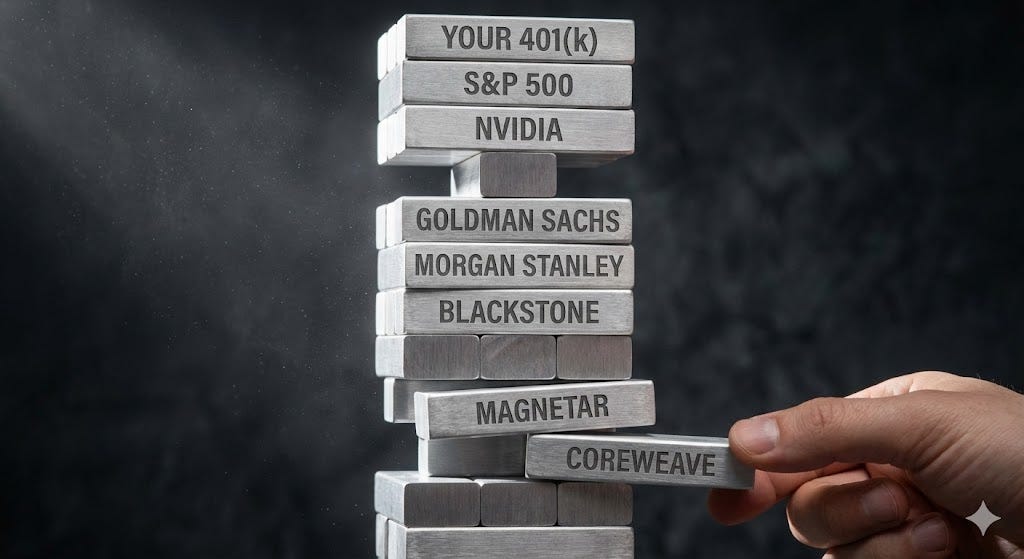
In The Big Short, there’s a scene where a Deutsche Bank trader uses a Jenga tower to explain how AAA-rated mortgage tranches depended structurally on subprime borrowers at the base. Remove the bottom blocks, and “safe” becomes rubble.
Rebuild the tower with GPUs.
The bottom blocks — the B and BB tranches — are CoreWeave’s equity and Magnetar’s position. CoreWeave’s common stock is the most junior claim in the entire structure. If anything goes wrong — revenue misses, GPU utilization drops, refinancing stalls — equity holders absorb the first losses. Magnetar is the largest block at the bottom of the pile. They have been steadily selling and have bought put options in case the stock falls. [6] The biggest block at the bottom is being loosened. Right next to it: CoreWeave’s $2.25 billion in convertible notes [23], which are designed to convert into equity, meaning they slide down to the bottom the moment stress arrives.
The middle of the tower is CoreWeave’s debt stack. The early facilities at 15% and 11% interest rates. [18] The $2.6 billion term loan. [22] The $1.75 billion in senior secured bonds. [18] These blocks look more solid; they have contractual claims on CoreWeave’s assets, covenants, and the financial conditions CoreWeave must meet to avoid default (loosened as they are), which provide some protection and security interests in the GPUs themselves. But they’re sitting on top of an equity layer whose interest coverage is either adequate or catastrophic, depending on which depreciation assumptions you believe, and they depend on a company that must service $4.2 billion in scheduled debt payments this year [18] while spending far more on expansion than its operations currently generate.
The upper blocks — the ones labeled AAA — are where the rest of us live. Blackstone’s infrastructure funds, backed by pension capital from 100 million retirees. [30] The banking syndicate — Morgan Stanley, Goldman, JPMorgan, Wells Fargo — is still holding GPU-backed loans on their own balance sheets that they arranged but couldn’t fully sell on to other investors. Nvidia’s roughly $4.5 trillion market cap, which embeds the assumption that every GPU it ships will be utilized at rates justifying the debt that financed its purchase. And at the very top: the S&P 500 index fund in your 401(k), roughly 35% concentrated in seven companies, several of which are spending a combined $300 billion or more in 2025 capital expenditure alone on the AI infrastructure that CoreWeave and its peers are supposed to provide.
In 2008, the blocks were contractually linked. Each CDO tranche had a legal claim on the same pool of mortgages, so the failure of lower tranches mechanically impaired the ones above. The GPU tower isn’t connected that way. CoreWeave’s equity, Magnetar’s fund, Blackstone’s infrastructure platform, the banking syndicate, and your index fund are different entities connected by business relationships and shared assumptions, not by contractual subordination. But markets don’t need contractual links to propagate fear. They need a narrative.
So consider what happens if the narrative changes.
Magnetar’s sustained selling has already signaled to the market that the historical investor is reducing exposure. [10] [11] If CoreWeave’s Q4 earnings disappoint on February 26 [14], there is no reason to expect Magnetar to absorb the selling, as it has been the seller. Every other institutional holder runs the same calculus: if Magnetar is out and hedged, why am I still holding?
If selling pressure drives the stock through Magnetar’s $70 put strike [6], the equity cure mechanism, CoreWeave’s tool for meeting debt covenants by issuing stock [25], breaks. No one buys a secondary offering from a company whose stock is in free fall. Without equity cures, the loosened covenants tighten. When CoreWeave breaks the terms of one loan, clauses in its other loans automatically trigger, meaning a single default can cascade across the entire debt stack. [22] The 2026 debt payments become unserviceable.
The signal radiates outward. Magnetar co-led two of the largest private credit deals in neocloud history. [21] If the firm that architected GPU-backed finance is unwinding its own exposure — not because of a crisis, but in anticipation of one — every bank in the syndicate re-evaluates its own book. Lambda’s Macquarie facility [26], Crusoe’s Brookfield facility [27], FluidStack’s GPU-collateralized loans [28], all reprice. New lending tightens. The neoclouds that need to refinance constantly face higher rates or frozen markets.
Blackstone takes a direct hit. Its hedge fund unit bought a minority stake in Magnetar in 2015. [1] It also led $7.5 billion in CoreWeave debt [21] and has made AI infrastructure the centerpiece of its investment thesis. [30] A Magnetar exit accompanied by $70 put options validates every bear case about Blackstone’s AI bet at the worst possible moment. Blackstone’s own stock reprices. Its ability to raise the next AI infrastructure fund is becoming more difficult. Since Blackstone deploys capital from pension funds serving over 100 million people [30], that repricing affects real-world retirement portfolio returns.
In 2008, the contractual links proved inescapable. In this tower, the link is the market's belief about AI demand, and beliefs can shift in an afternoon.
The Path to Systemic
Here is where the story diverges from every housing-crisis comparison, and where it matters most.
The total neocloud debt market is perhaps $20-30 billion, with broader AI infrastructure financing (including hyperscaler commitments) in the hundreds of billions. This is large, but it is not systemically threatening through the banking channel. A neocloud credit event, by itself, is a bad quarter for specific banks and private equity firms. It is not a financial system crisis.
The systemic path doesn’t run through debt. It runs through equity.
The mechanism works in stages. First, a CoreWeave credit event — a covenant breach, a failed refinancing, a guidance disaster — forces a repricing of GPU-backed debt across the neocloud sector. That repricing is painful but contained: Blackstone takes write-downs, some banks report losses, and private credit funds mark down positions. This is a bad earnings season, not a crisis.
The repricing generates analyst reports, news coverage, and a question: if the most heavily financed neoclouds are struggling to service their debt, what does that say about the demand assumptions underpinning the companies that sell them chips? Nvidia reports earnings on February 25 [43], one day before CoreWeave [14]. If Nvidia’s guidance disappoints, or even if it meets expectations while the narrative around its customer base is souring, the repricing moves from private credit to public equity.
Nvidia’s market capitalization is roughly $4.5 trillion. A 50% decline — the kind that accompanied Cisco’s correction after the telecom bust — would destroy more than $2 trillion in market value. But Nvidia doesn’t exist in isolation. If the market determines that the demand projections underpinning Nvidia’s valuation were overly optimistic, the re-rating would extend immediately to Microsoft, Amazon, Google, and Meta, companies that spent a combined $300 billion or more on 2025 capital expenditures, much of it directed at AI infrastructure. These companies are priced for growth. When the growth story cracks, the premium evaporates across every company that was priced for it.
The transmission mechanism from “Nvidia’s growth rate disappoints” to “your 401(k) drops” is index concentration. The S&P 500 is approximately 35% concentrated in seven technology companies. A 40% decline in the Mag 7 corresponds to roughly a 14% decline in the S&P 500, before contagion to the other 493 companies, which also fall because investors sell index funds rather than individual stocks. The average American’s retirement savings are overwhelmingly invested in index funds and target-date funds that share the same names.
The contagion vector isn’t debt cascading through the banking system. It’s the wealth effect flowing through index concentration. It’s the 401(k) that drops 20% because the S&P 500 dropped 20% because the Mag 7 dropped 40% because Nvidia dropped 50% because the market decided GPU demand wasn’t growing fast enough to justify the debt that financed it. Each step in that chain is a separate decision by distinct actors—analysts, portfolio managers, and 401(k) holders who panic-sell —but the structure makes them correlated. They all depend on the same belief: that AI demand is growing exponentially.
This is not 2008, when the contractual linkages were hidden. The linkages here are visible. They’re priced into every earnings multiple, every index weight, every capital expenditure guidance. The risk isn’t that nobody sees it. The risk is that everyone observes it simultaneously.
What This Is
This is not a prediction. The most likely outcome is still that demand grows, refinancing succeeds, and these companies earn their way out.
However, the structure doesn’t care about your base case. The structure is what remains when the base case is incorrect.
$20 billion in GPU-collateralized debt, anchored by a hedge fund that, as ProPublica reported, helped structure CDOs in 2008 while simultaneously betting they’d fail [2] — and that has now been selling its position for months while purchasing crash protection expiring three weeks after Q4 earnings [6]. A supplier that is simultaneously an investor, customer, and implicit guarantor of its own demand. [33] [34] [35] Pension capital from a hundred million retirees deployed into an asset class that didn’t exist three years ago. [30] And an index fund in your 401(k) that is, functionally, a leveraged long position on whether AI inference demand grows exponentially.
The coupling already exists. The debt has already been issued. The covenants have already been loosened. [25] The index concentration has already made “I own a diversified fund” mean less than it sounds. And the most informed money in the structure is already repositioning.
Now we know the structure we’re in.
CoreWeave reports Q4 2025 earnings on February 26, 2026.
Sources
[1] Magnetar Capital LLC. Approximately $26 billion in total assets under management as of mid-2025 per Crain’s Chicago Business reporting ($22.8 billion discretionary per 2024 SEC Form ADV). Headquarters: 1603 Orrington Avenue, Evanston, IL. Blackstone Alternative Asset Management acquired a minority stake in 2015.
[2] ProPublica, “The Magnetar Trade: How One Hedge Fund Helped Keep the Bubble Going,” April 9, 2010. Pulitzer Prize-winning investigation. https://www.propublica.org/article/the-magnetar-trade-how-one-hedge-fund-helped-keep-the-housing-bubble-going
[3] Magnetar Financial LLC, SEC Form 13F-HR, filed February 17, 2026, for the quarter ending December 31, 2025. 68,191,394 shares of CoreWeave Class A common stock, valued at $4.883 billion, representing 48% of Magnetar’s $10.2 billion reported 13F portfolio. Next largest position (Chart Industries) at 1.0%. https://13f.info/13f/000110465926015538-magnetar-financial-llc-q4-2025
[4] CoreWeave press release, “CoreWeave, Specialized Cloud Provider, Raises $50 Million in New Capital from Magnetar,” November 10, 2021. https://www.prnewswire.com/news-releases/coreweave-specialized-cloud-provider-raises-50-million-in-new-capital-from-magnetar-301420451.html
[5] Magnetar Financial LLC, SEC Form 13F, filed for the quarter ending September 30, 2025. 91.4 million shares of CoreWeave at ~72% of Magnetar Financial’s $20.5 billion 13F portfolio, as reported by Benzinga, “CoreWeave Turns $50 Million Convertible Notes Into $12.5 Billion AI Jackpot For This Hedge Fund (Corrected),” October 8, 2025. https://www.benzinga.com/markets/hedge-funds/25/10/48102067/
[6] Sherwood News, “CoreWeave tumbles as top shareholder Magnetar dials down position, puts on huge collar trade,” September 2, 2025. Details: $91.7M August 15 sale; 600K puts at $70 / calls at $175 (Thursday); 801K puts at $70 / calls at $160 (Wednesday); March 20, 2026 expiry; 22% net debit on puts. https://sherwood.news/markets/coreweave-tumbles-as-top-shareholder-magnetar-dials-down-position-puts-on/
[7] Investing.com, “Magnetar Financial sells CoreWeave (CRWV) shares for $8.7 million,” October 8, 2025. Details of the October 7 sale of 63,035 shares. https://www.investing.com/news/insider-trading-news/magnetar-financial-sells-coreweave-crwv-shares-for-87-million-93CH-4276085
[8] Investing.com, “Magnetar Financial sells CoreWeave (CRWV) stock worth $26.8 million,” October 11, 2025. Details: October 10 sale of 181,000 shares. https://www.investing.com/news/insider-trading-news/magnetar-financial-sells-coreweave-crwv-stock-worth-268-million-93CH-4282892
[9] SEC Form 4 filings by Magnetar Financial LLC for CoreWeave, Inc. (CRWV), filed throughout August–December 2025. Individual sale dates and amounts sourced from these filings. Available via SEC EDGAR.
[10] Crain’s Chicago Business, “Magnetar sold $1.9B in CoreWeave shares as insiders, investors started cashing in,” October 10, 2025. Reports $1.9B sold, >20% Class A shares retained per October filing. https://www.chicagobusiness.com/finance-banking/magnetar-sold-19-billion-coreweave-shares
[11] Sherwood News, “CoreWeave slumps after filings show top shareholder Magnetar Financial sold over $500 million in stock last week,” October 20, 2025. Reports Magnetar still held “north of 72 million shares.” https://sherwood.news/markets/coreweave-slumps-after-filings-show-top-shareholder-magnetar-financial-sold/
[12] SEC Form 4 filings by Brian Venturo, Michael Intrator, and Brannin McBee for CoreWeave, Inc. (CRWV), filed late December 2025. Available via SEC EDGAR.
[13] SEC Form 4 filing by Magnetar Financial LLC, September 10, 2025. Details second collar: 392,632 shares across four tranches; $82.50 puts / $200 calls; June 18, 2026 expiry. Reported via StockTitan: https://www.stocktitan.net/sec-filings/CRWV/form-4-core-weave-inc-insider-trading-activity-f3e817c73bb2.html
[14] CoreWeave, Inc. press release via Business Wire, “CoreWeave Announces Date of Fourth Quarter and Fiscal Year 2025 Financial Results and Conference Call,” February 5, 2026. Earnings call set for February 26, 2026. https://investors.coreweave.com/news/news-details/2026/CoreWeave-Announces-Date-of-Fourth-Quarter-and-Fiscal-Year-2025-Financial-Results-and-Conference-Call/
[15] CoreWeave, Inc. press release via PR Newswire, “CoreWeave Appoints Ernie Rogers to Strategic Leadership Role to Drive Next Phase of Financing Growth,” June 4, 2025. Rogers was identified as a former COO at Magnetar. https://www.prnewswire.com/news-releases/coreweave-appoints-ernie-rogers-to-strategic-leadership-role-to-drive-next-phase-of-financing-growth-302473205.html
[16] PitchBook, “How a $50M loan to CoreWeave became Magnetar Capital’s boldest bet,” May 13, 2025. Reports Magnetar venture fund GPU compute access deal with CoreWeave. https://pitchbook.com/news/articles/magnetar-capital-coreweave-ai-investment
[17] Beehiiv / Renaissance Capitalist, “The Magnetar Trade: CoreWeave (AI) Edition,” April 19, 2025. Reports CoreWeave $50M investment into Magnetar’s venture fund. Referenced in CoreWeave S-1/A filing. https://renaissancecapitalist.beehiiv.com/p/the-magnetar-trade-coreweave-ai-edition
[18] CoreWeave, Inc. Form 10-Q for quarter ending September 30, 2025, filed November 13, 2025. Source for: ~$14B interest-bearing debt plus ~$4.7B lease obligations, interest expense $311M, GAAP operating income $51.9M, depreciation/amortization $630.5M, interest rates on tranches, 2026 debt amortization schedule, banking syndicate members, lending syndicate participants, 6-year GPU depreciation. SEC EDGAR: https://www.sec.gov/Archives/edgar/data/1769628/000176962825000062/crwv-20250930.htm
[19] Amazon.com, Inc. Q4 2024 Earnings Call Transcript, February 6, 2025. CFO Brian Olsavsky on server depreciation reversal from 6 years to 5 years for AI-related hardware. Available via investor relations: https://ir.aboutamazon.com/
[20] CoreWeave, Inc. Form S-1 Registration Statement, filed March 2025. Company history: founded in 2017; Ethereum-mining origin; AI pivot in 2019. SEC EDGAR.
[21] PitchBook, “How a $50M loan to CoreWeave became Magnetar Capital’s boldest bet,” May 13, 2025. Reports: $7.5B facility May 2024 co-led by Magnetar and Blackstone; $2.3B facility 2023. https://pitchbook.com/news/articles/magnetar-capital-coreweave-ai-investment
[22] CoreWeave, Inc. Form 8-K, filed July 31, 2025. DDTL 3.0 Credit Agreement dated July 28, 2025, $2.6B term loan. MUFG as administrative agent. Covenant details, including debt service coverage ratio and cross-default provisions. https://www.sec.gov/Archives/edgar/data/1769628/000176962825000033/crwv-20250728.htm
[23] CoreWeave, Inc. Form 8-K, filed December 2025. $2.25 billion convertible senior notes, 1.75% interest, maturing December 1, 2031. SEC EDGAR.
[24] CoreWeave, Inc. Q3 2025 Earnings Press Release and Earnings Call, November 10, 2025. Adjusted EBITDA $838M (61% margin), revenue $1.36B (134% YoY growth), backlog $55.6B. Microsoft accounted for 62% of Q3 revenue; management stated that no single customer exceeds ~35% of the forward backlog. https://www.sec.gov/Archives/edgar/data/1769628/000176962825000059/coreweave3q25earningspress.htm
[25] CoreWeave, Inc. Form 8-K, filed January 2, 2026. Amendment to DDTL 3.0 Credit Agreement dated December 31, 2025. Minimum liquidity reduced to $100M (March–April 2026); DSCR testing postponed to October 31, 2027; unlimited equity cures permitted before October 28, 2026. https://www.sec.gov/Archives/edgar/data/1769628/000176962826000003/crwv-20251231.htm
[26] Lambda Labs public announcements and press coverage of $500M Macquarie GPU-collateralized loan and $275M JPMorgan credit facility. Various news sources, including The Information and Bloomberg.
[27] Crusoe Energy's public announcements regarding the $750M Brookfield credit facility. Various news sources.
[28] The Information, reporting on FluidStack $10B+ GPU-collateralized credit line from Macquarie and other lenders. (Subscription source.)
[29] Various news sources, including Bloomberg, The Information, and Financial Times, are reporting on xAI $20B SPV financing: $7.5B equity / $12.5B debt, secured by Nvidia GPUs, Nvidia $2B equity investment.
[30] Blackstone, Inc. Q4 2025 Earnings Call and Supplement, January 2026. AUM $1.3T; infrastructure platform $77B (40% growth); QTS as largest return driver; AI as “highest conviction theme”; retirement benefits for 100M+ people. https://www.blackstone.com/investor-relations/
[31] Blackstone press releases and news coverage of $25B Pennsylvania AI data center investment commitment.
[32] Blackstone press releases on $3B partnership with Saudi Arabia’s Humain for AI infrastructure.
[33] Nvidia Corporation Form 13F, filed August 2025 for quarter ending June 30, 2025. Reports 24.28 million CoreWeave shares; CoreWeave represents >91% of Nvidia’s public equity portfolio. Reported via The Street, August 17, 2025: https://www.thestreet.com/technology/nvidia-quietly-boosts-its-bet-on-an-ai-infrastructure-favorite
[34] Nvidia and CoreWeave joint press release, “NVIDIA and CoreWeave Strengthen Collaboration to Accelerate Buildout of AI Factories,” January 26, 2026. Nvidia purchased 22.94M newly issued Class A shares at $87.20, total $2B investment, bringing stake to ~13%. Reported via Sherwood News: https://sherwood.news/markets/coreweave-spikes-after-nvidia-buys-an-additional-usd2-billion-neoclouds-shares/; Next Platform analysis: https://www.nextplatform.com/2026/01/27/nvidias-2-billion-investment-in-coreweave-is-a-drop-in-a-250-billion-bucket/
[35] CoreWeave, Inc. disclosed a $6.3 billion Nvidia capacity guarantee through 2032, disclosed September 2025 in the expanded Master Services Agreement. Reported in Motley Fool analysis: https://www.fool.com/investing/2025/09/27/nvda-investors-coreweave-could-juice-profits/
[36] Yahoo Finance interview with Jim Chanos, 2025. Chanos quote on Nvidia vendor financing parallels to Lucent.
[37] Bernstein research note by Stacy Rasgon, 2025. Rasgon noted Nvidia’s customer investments “will fuel [circular concerns] further.” Reported via Yahoo Finance and CNBC coverage of Nvidia vendor financing debate, November 2025.
[38] Nvidia seven-page memo to analysts denying vendor financing characterization, 2025. Reported across financial media.
[39] Jensen Huang public remarks that investment recipients are not contractually required to spend on Nvidia chips. Various press coverage.
[40] Nvidia Corporation Q4 FY2025 Earnings Release, February 26, 2025. Q4 revenue $35.6B (93% YoY), FY2025 revenue $130.5B, gross margins >70%. Q3 FY2026 balance sheet (October 26, 2025): cash, cash equivalents, and marketable securities $60.6B per CFO Commentary. https://nvidianews.nvidia.com/news/nvidia-announces-financial-results-for-fourth-quarter-and-fiscal-2025
[41] Silicon Data H100 Rental Index and multiple cloud marketplace pricing data aggregators tracking H100 spot pricing 2024-2025.
[42] AWS pricing announcements, mid-2025. H100 instance pricing reduction of approximately 44%. Various press coverage.
[43] Nvidia Corporation press release via Globe Newswire, “NVIDIA Sets Conference Call for Fourth-Quarter Financial Results,” January 28, 2026. The earnings call is confirmed for February 25, 2026. https://nvidianews.nvidia.com/news/nvidia-sets-conference-call-for-fourth-quarter-financial-results-6916259
[44] Data Center Dynamics, “Chipping away at the economics of neoclouds,” October 9, 2025. Scaleway CEO Damien Lucas on three-year GPU depreciation assumption based on 18-month generation cycles. https://www.datacenterdynamics.com/en/analysis/chipping-away-at-the-economics-of-neoclouds/
[45] Fortune, “Anthropic CEO Dario Amodei explains his spending caution, warning if AI growth forecasts are off by just a year, ‘then you go bankrupt,’” February 14, 2026. From an interview with Dwarkesh Patel, February 2026. https://fortune.com/2026/02/14/anthropic-ceo-dario-amodei-spending-capex-risk-ai-revenue-forecasts-bankruptcy/
[46] Deutsche Bank, via Fortune, November 28, 2025. https://fortune.com/2025/11/28/openai-partners-96-billion-debt/
Disclaimer
I hold long positions in several cloud and AI stocks. CoreWeave is not one of them. I do not hold any short positions. This article is an analysis, not investment advice. I have no relationship with Magnetar Capital, CoreWeave, or any entity discussed here beyond publicly available information. Do your own research.