

On February 11, 2026, Moody’s awarded its first-ever Aaa rating to a data center securitization — an $830 million deal from Compass Datacenters backed by six hyperscale facilities with 100% lease rates [1]. The senior tranche — the safest, first-to-be-paid slice of the deal — priced at 120 basis points over SOFR, the benchmark rate that replaced LIBOR. This was, in Moody’s judgment, among the safest debt instruments in the world — the same rating it gives to U.S. Treasury bonds.
Around the same time, the credit default swap (CDS) market — where investors buy insurance against a borrower defaulting on its debt — was pricing CoreWeave at roughly 640-700 basis points [2][3]. Those are November–December 2025 readings—the most recent independently sourced figures available, and the spread may have moved since [4]. But even at the low end, the implied five-year cumulative default probability is 40-55%, depending on recovery assumptions [4]. Near a coin flip. The market’s skepticism quickly found validation. In February 2026, a securities fraud class action was filed against CoreWeave, alleging that the company had overstated its ability to meet customer demand and concealed its dependence on a single data center supplier whose construction delays triggered a 34% stock decline [26]. The CDS market, it turned out, had been pricing real risk all along.
To be fair, the CDS market may be pricing CoreWeave-specific distress, not sector-wide contagion — Oracle, another major data center borrower, trades at 104 bps, firmly investment-grade [2]. But the collateral depreciation problem isn’t CoreWeave-specific. Every neocloud holding H100s sits on the same depreciation curve. CoreWeave may be the canary or the exception. The market hasn’t decided which.
One market is stamping triple-A on AI infrastructure. Another is pricing the sector’s most prominent borrower at close to even odds of blowing up.
Both markets are trading instruments built on the same underlying asset class: GPUs and the data centers that house them. GPUs that have lost 70-80% of their rental value in under two years [5].
The most consequential time two markets reached opposite conclusions about the same underlying asset class was 2006. The asset was housing.
The dissonance is the story
The Compass deal that received Moody’s Aaa is backed by physical facilities leased to investment-grade hyperscalers [1]. CoreWeave’s debt is backed by NVIDIA GPUs leased to AI companies under contracts of varying quality. Different borrowers, different structures, different collateral quality.
But both instruments sit atop the same macro bet: that demand for AI compute will sustain the economics of the infrastructure built to serve it. The Aaa-rated facility houses GPUs. CoreWeave’s debt is collateralized by GPUs. The hyperscalers whose leases make one deal “safe” are the same companies whose capex plans create the demand that makes the other deal viable. It’s one ecosystem. The structural protections in the Compass deal — 15-year leases, investment-grade tenants, $3.6 billion in appraised real estate — are designed to survive a downturn. But lease renewals depend on sustained capex commitments. If hyperscalers cut AI infrastructure spending, the facilities don’t go dark overnight — but the pipeline of new deals, refinancings, and issuance that sustains the securitization market does.
This isn’t a contradiction that resolves neatly. It’s a market structure question. In the securitization market, you’re buying the deal’s collateral, its lease contracts, its structural protections — you’re buying cash flows. In the CDS market, you’re buying insurance against a borrower’s ability to meet its debt obligations — a bet on the creditworthiness of the entire enterprise. One is micro. The other is macro. But when the micro and macro are this far apart on the same underlying asset, one of them is wrong.
And the foundation may be less stable than the ratings suggest. The Aaa depends on the creditworthiness of the hyperscaler tenants. But those tenants are themselves leveraging up to sustain the AI capex that creates the demand the entire securitization stack depends on. In 2025, the five major hyperscalers issued roughly $121 billion in new debt; Morgan Stanley projects $400 billion in hyperscaler bond issuance for 2026 alone [21][28]. AI capex is now consuming nearly 100% of operating cash flow, up from a ten-year average of 40% [28]. Amazon is projected to go free cash flow negative in 2026 — for the first time — with Morgan Stanley estimating a deficit of $17 billion [28]. Alphabet’s free cash flow is projected, by one widely cited estimate, to plummet roughly 90% [28].
On aggregate, hyperscalers now hold more debt than cash [28]. Evercore's Julian Emanuel warned on February 17 that hyperscaler forward free cash flow has plummeted below 2022 cycle lows, calling aggregate negative FCF a "major red flag”, the kind of language sell-side analysts reserve for when they want to be on the record before something breaks. [31]
The circularity is structural: hyperscalers borrow to fund AI capex; that spending enables the neocloud and data center borrowing that gets packaged into securitizations; those securitizations create the reference assets for the CDS and derivatives infrastructure being built around them.
The credit anchor of the Aaa-rated tranche is itself becoming a borrower, and that borrowing feeds the pipeline.
A twenty-year progression compressed into two
What makes GPU infrastructure debt different from other asset classes isn’t just the dissonance. It’s the speed.
The mortgage-backed securities market took roughly two decades to fully develop its architecture. The first mortgage pass-throughs appeared in the 1970s. CMOs (collateralized mortgage obligations, which split mortgage pools into multiple bond classes) and tranching (slicing debt pools into layers from safest to riskiest) arrived in the 1980s. Rating agencies developed MBS methodologies through the 1990s. Credit default swaps on mortgage pools emerged in the early 2000s. Synthetic CDOs — collateralized debt obligations built from derivatives rather than actual loans, the instruments that amplified losses in 2008 — didn’t reach scale until 2004-2006. From first securitization to systemic crisis: about thirty years.
GPU infrastructure debt is running the same progression on fast-forward:
2023: First GPU-collateralized loans (Magnetar/Blackstone to CoreWeave, $2.3 billion) [6].
Mid-2024: First GPU-backed asset-backed securities, or ABS (Lambda Labs, $500 million via Macquarie) [7].
Early 2025: AAA-rated senior notes on GPU ABS priced inside 110 basis points [7].
Late 2025: CDS market active on GPU-adjacent names; CoreWeave CDS liquid enough for Bloomberg terminals and Deutsche Bank daily research notes [2].
February 2026: First Moody’s Aaa on a data center securitization [1]. First over-the-counter (OTC) compute swap — a private contract letting parties bet on or hedge against GPU price movements — executed [8]. Compute futures exchange — where standardized contracts on future GPU prices would trade publicly — under construction [9]. Perpetual futures on GPU rental prices are about to launch [10].
Three years. Not thirty. Three.
To be clear: the GPU debt market is orders of magnitude smaller than the pre-crisis mortgage market. At the current scale, a total wipeout of GPU-backed securities would not threaten the financial system. The danger isn’t today’s size — it’s that the securitization and derivatives infrastructure is being assembled before the market is large enough for anyone to treat systemic risk as their problem.
And the progression isn’t abstract. There’s a checklist, and the market is methodically working through it:
✅ GPU-collateralized loans ($20B+) [5]
✅ Securitized (ABS/CMBS: $34.4B, 69 deals) [11]
✅ Single-name CDS market [2]
✅ Price indices (Bloomberg-listed) [8][12]
⏳ Exchange-traded derivatives (Ornn, AX, Compute Exchange) [8][10][13]
❌ Synthetic CDOs / CDS on baskets of GPU debt
❌ CDO-squared equivalents
Every prerequisite for the synthetic layer now exists. Moody’s is already listing “infrastructure asset CLOs” (collateralized loan obligations — cash structures that buy actual loans, not derivatives, but representing the next layer of complexity before the synthetic layer) as an applicable rating methodology for data center financings — signaling that CLO-like structures are either emerging or on the near horizon [14].
The only thing missing is someone packaging CDS on pools of GPU-backed debt into tranched, rated securities. Given the velocity of everything else, “not yet” is not the same as “not coming.”
The securitization pipeline nobody’s watching
The data center ABS/CMBS (commercial mortgage-backed securities) market has quietly become one of the fastest-growing segments in structured finance. Through mid-November 2025, issuance totaled $23.8 billion — split between $11.2 billion in ABS and $12.6 billion in CMBS — more than double the full-year 2024 total [11]. Cumulative issuance across the sector: $34.4 billion across 69 deals, 19 issuers, and 106 tranches [11]. Average deal size has grown from $320 million in 2022 to $1.1 billion in 2025 [11].
The projections suggest this is still early. DoubleLine Capital projects $50 billion outstanding by 2027. Morgan Stanley sees $25 billion in annual issuance by 2028. JPMorgan projects $30-40 billion in annual issuance for 2026-2027 alone [15]. Data centers already account for 13% of the entire single-asset, single-borrower CMBS market [15].
And investors are fighting to get in. Blackstone’s QTS data center CMBS — a $3.46 billion deal — saw its junior notes oversubscribed 23 times [16]. Not the senior tranche. The junior notes — the last-to-be-paid, riskiest slice of AI infrastructure debt. Deutsche Bank’s Jim Reid, looking at the same asset class from the CDS side, concluded that investors were “increasingly looking to hedge their risk” [2]. One group of investors is 23x oversubscribing the riskiest tranche. Another is paying 640 basis points for insurance against exactly that risk.
What makes this structurally dangerous is the split among rating agencies. S&P caps the entire data center ABS sector at A+. Moody’s has now assigned a specific deal — comprising 15-year hyperscaler leases and $3.6 billion in real estate — an Aaa rating [1]. That’s a multi-notch methodological gap on the same asset class. The last time rating agencies diverged this sharply on structured products backed by a novel collateral type, the collateral was residential mortgages. That divergence expands the buyer base — pension funds and insurance companies restricted to AAA-rated holdings can now buy data center ABS that Moody’s has blessed, but S&P would cap several notches lower. More buyers mean issuers can sell more deals at tighter pricing, which makes borrowing cheaper and incentivizes more issuance — regardless of whether the underlying risk has changed.
And the collateral problem I mapped in “What a GPU Debt Crisis Would Look Like” — where every GPU in every neocloud depreciates roughly on the same curve, creating the same correlated-default risk as housing prices in 2006 — applies with full force to the securitization layer. The depreciation models baked into these securities assume GPUs retain 50% of their value after three years [7]. Those assumptions were set when H100s rented for $8-$10 per hour. They now rent for around $2 [5]. When NVIDIA releases a new generation, it doesn’t hit one borrower’s collateral — it hits all of them simultaneously. The securitization market hasn’t priced that correlation yet [17].
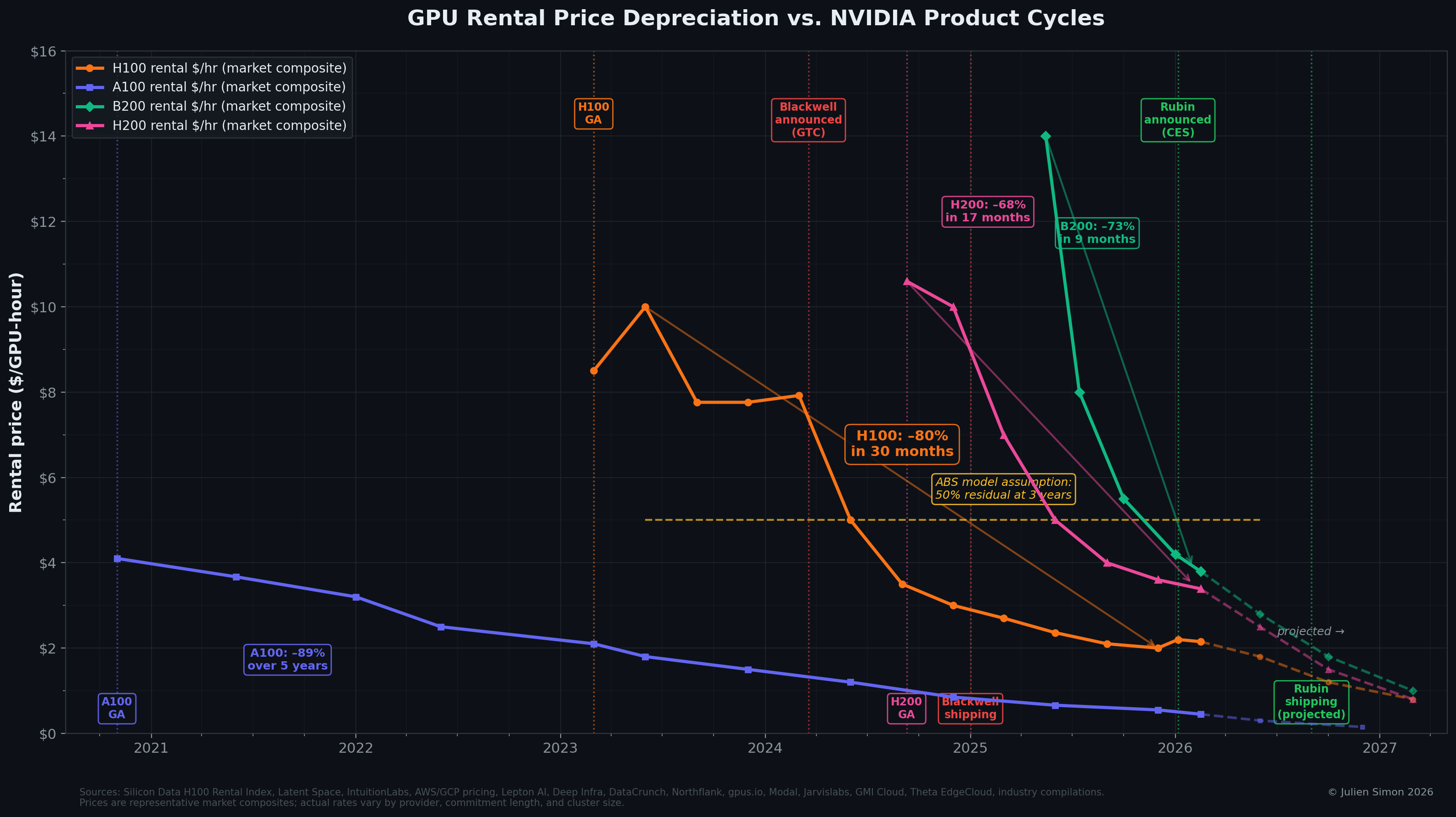
The opening chart below shows what that depreciation looks like in practice — and why it matters for every GPU-backed securitization outstanding.
The pattern is clear. H100 rental prices fell 80% in 30 months — blowing through the ABS models’ 50%-at-three-years assumption roughly 18 months ahead of schedule. The H200 — a memory upgrade on the same Hopper architecture — fell 68% in just 17 months, from $10.60 at AWS’s September 2024 launch to a $3.39 median today. The A100 shows the longer arc: an 89% decline over five years, accelerating after its successor shipped. And the B200 — the current flagship — has fallen 73% in just 9 months, from $14 per hour at AWS’s May 2025 launch to specialist providers already offering it for below $3 per hour, with Rubin six months away.
Each generation depreciates faster than the last. At GTC 2025, Jensen Huang said it plainly: “When Blackwell starts shipping in volume, you couldn’t give Hoppers away” [29]. SemiAnalysis estimates that an H100 would need to rent at $0.98 per hour — a further 55% cut from current levels — just to match Blackwell’s price-per-output [29]. Rubin, announced at CES in January 2026 and shipping in the second half of 2026, promises 5x the inference performance of Blackwell and a 10x reduction in the cost per token [30]. Every GPU used as loan collateral today sits on this treadmill.
Depreciation isn’t a risk factor: it’s a product feature. NVIDIA’s annual cadence is the mechanism that makes correlated collateral impairment not just possible but inevitable.
Fitch has published a public consultation asking whether GPU depreciation should be formally incorporated into its ratings of securitizations backed by AI infrastructure [18]. That’s a building block: you can’t rate complex products built on top of GPU-backed debt until you have models for the underlying debt itself.
The compute derivatives market nobody’s covering
While the credit markets debate CoreWeave’s survival, a separate ecosystem is quietly building the infrastructure for a full-blown compute-derivatives market.
Ornn AI has executed its first OTC compute swap — a derivative contract based on GPU prices. This is no longer theoretical [8]. The company operates under a CFTC exemption that allows up to $8 billion in swap volume without full regulatory oversight, while it pursues a license to operate as a full exchange [8][9]. It has built a live price index tracking H100, H200, B200, and RTX 5090 GPUs — the reference prices that derivatives need to exist [8]. In January 2026, Ornn expanded into DRAM memory futures, targeting a market where prices swing 250% annually [8].
Ornn’s most consequential product may be its Residual Value Swaps. The mechanics: a GPU owner — say, a neocloud or a lender holding collateral — pays Ornn a quarterly premium. In return, Ornn guarantees a resale price at contract end (economically, a put option, regardless of what the product is called) [8]. This directly addresses the collateral depreciation problem haunting every GPU-backed lender. If an H100 that was worth $30,000 in 2023 is worth $8,000 in 2026, the lender holding that GPU as collateral against a $20,000 loan has a problem. A Residual Value Swap would have locked in a floor price at origination.
The implications for the securitization market are significant. The central problem with GPU-backed lending is that the collateral depreciates rapidly and unpredictably. If Residual Value Swaps develop sufficient liquidity, lenders could lock in a floor price at origination, removing the depreciation risk that haunts every GPU-backed loan. That confidence would let them lend more, at lower rates, to more borrowers — expanding the market. This isn’t hypothetical: Ornn has already partnered with USD.ai, which provides GPU infrastructure loans, to offer put options on hardware in years 3-4 — giving lenders exactly this capability [8].
But there’s a darker possibility. Every hedging instrument is also a speculative instrument. A Residual Value Swap that protects a lender’s collateral also lets a hedge fund bet on GPU depreciation without owning a single chip.
And the counterparty risk is concentrated in ways that should sound familiar. Ornn — a startup with $5.7 million in funding — is the entity guaranteeing resale prices on hardware that depreciates 70-80% in two years. If GPU prices drop faster than Ornn’s models predict, or if swap volume grows faster than its balance sheet, the guarantees become liabilities the guarantor can’t cover.
This is the AIG problem in miniature. In 2008, AIG had written enormous amounts of insurance on mortgage-backed securities. But AIG wasn’t destroyed by actual mortgage defaults. It was destroyed by collateral calls: as the market deteriorated, AIG’s counterparties demanded cash to back up the guarantees — cash AIG didn’t have. The liquidity crisis hit before the losses materialized. Ornn’s structure may be worse in one respect: AIG at least had some margining requirements that made the problem visible in real time. Ornn likely has no such framework, which means its counterparties may not know a guarantee is impaired until Ornn can’t pay.
The difference is scale — Ornn is tiny. The similarity is in structure. And if the swap market grows faster than the underlying physical market — which is exactly what happened with credit default swaps on mortgage bonds, where the bets eventually dwarfed the loans themselves [25] — the derivatives tail starts wagging the physical-market dog. The compute derivatives market is nowhere near that point today. But the infrastructure to get there is being built.
Meanwhile, the exchange layer is coming in behind the OTC market. Architect Financial Technologies (AX), a Bermuda-regulated exchange led by former FTX US president Brett Harrison, is about to launch perpetual futures on GPU rental prices [10]. Compute Exchange, backed by trading giant DRW, projects a potential $5 trillion derivatives market [13]. OneChronos has partnered with Nobel laureate Paul Milgrom to build a combinatorial auction market for GPU compute [19].
Current trading volume across all of them is effectively zero. This is pre-revenue infrastructure — exchanges built for a market that doesn’t exist yet.
But that’s how every derivatives market starts. Oil futures were marginal curiosities in the early 1980s. Credit default swaps were an obscure JPMorgan innovation in the mid-1990s. The market infrastructure for compute derivatives is further along in 2026 than either of those was at comparable stages. And none of the traditional exchanges — CME, ICE, Eurex — have entered the space. The entire compute derivatives market is being built by startups.
The regulatory vacuum
No regulator — in the United States or Europe — has issued a single piece of guidance specific to compute futures, GPU-linked derivatives, or GPU-backed securitization. The regulatory posture toward a market now measured in hundreds of billions is indistinguishable from the early 2000s approach to mortgage-backed securities: let innovation proceed, worry about systemic risk later.
The research arms of central banks see it clearly. The BIS warned in January 2026 that total IT-related investment — including AI infrastructure — has reached approximately 5% of U.S. GDP, exceeding the dot-com peak, and that IT firms are shifting from internal cash flows to external financing [20]. As I detailed in “The $3 Trillion Bet,” combined 2026 hyperscaler capex guidance now exceeds $660 billion [21]. The European Systemic Risk Board has identified five features of AI that “might significantly amplify systemic risks” [22].
The response from actual regulators: nothing. No CFTC guidance, no-action letters, or enforcement actions address compute futures. In its SEC scrutiny, the SEC targets GPU ABS as a distinct risk category. No banking regulator has issued guidance on concentration risk for AI infrastructure lending, despite $170 billion in project finance loans in 2025 [23]. No stress testing framework covers AI infrastructure debt scenarios.
Why? Three plausible explanations, all of which may be simultaneously true. First, the current U.S. administration’s deregulatory posture makes new derivatives oversight politically unlikely — the CFTC isn’t staffed or mandated to expand its remit into novel compute markets. Second, GPU securitization falls into a jurisdictional gap: banking regulators see the loans but not the ABS; securities regulators see the ABS but not the collateral risk; no one is looking at the system as a whole. Third, the expertise required to evaluate structured finance and the expertise required to evaluate GPU hardware economics rarely overlap — and the regulatory agencies responsible for each have no mechanism to pool what they know. This structural gap explains why the BIS and ESRB can identify the risk while U.S. regulators cannot act on it: European research bodies are organized around systemic risk as a category, while U.S. regulatory agencies are organized by asset class. A risk that spans asset classes falls through the cracks of an architecture built to monitor them individually.
The result: every major participant in the compute derivatives market operates in or through a different regulatory regime — CFTC de minimis, Bermuda, DeFi — and no single authority has visibility across all of them. The European research bodies are waving flags. The U.S. regulators who would need to act on those flags are looking the other way.
What resolves the dissonance
The AAA market and the near-default market can’t both be right simultaneously. One of three things resolves the tension.
Scenario 1: The securitization market is right. AI demand is real, sustained, and large enough to validate the infrastructure buildout. GPU rental rates stabilize or recover. Hyperscaler leases hold. CoreWeave refinances, possibly at painful terms but without default. The CDS market was overpricing idiosyncratic risk at a single distressed borrower and extrapolating it to a sector. Data center ABS becomes a boring, reliable asset class like utility bonds. The compute derivatives market matures into a functional hedging tool.
Scenario 2: The CDS market is right. GPU depreciation is faster than modeled. Rental rate compression continues. Neoclouds can’t service their debt. CoreWeave defaults or restructures, triggering contagion across the GPU-backed lending market. The AAA-rated tranches hold (they’re designed to), but even senior tranches trade down as the secondary market reprices the entire sector. Mezzanine and junior tranches take losses. The secondary market for used GPUs is flooded. Pension funds and insurance companies holding data center ABS discover their “safe” assets are correlated to the same technology cycle [24].
Scenario 3: Both are right, for a while, until they’re not. The securitization market correctly prices the senior tranches of well-structured deals with strong tenants. The CDS market correctly prices the specific risk of overleveraged neoclouds with depreciating collateral. Both coexist — until a trigger event (a major neocloud default, a GPU generational transition that accelerates depreciation, a hyperscaler capex cut) reveals the correlation between them. This is the 2006-2007 scenario: everyone’s right on their own deal until the systemic risk manifests.
The market is currently in Scenario 3. The question is how long it stays there — and whether the derivatives infrastructure now under construction will help manage the transition or amplify it. The most likely trigger is a hyperscaler capex revision driven by FCF exhaustion — with Amazon already projected to be negative and Alphabet’s free cash flow collapsing, board-level pressure to moderate spending is visible now, not speculative. A GPU generational transition that accelerates depreciation faster than the ABS models assume is near-certain, with only timing and magnitude in question. CoreWeave default, paradoxically, may be the least likely catalyst: its lenders have strong incentives to restructure rather than let a disorderly liquidation flood the GPU resale market and impair their own collateral.
The indicator lights to watch over the next twelve months:
CoreWeave CDS spread after Q4 earnings (February 26). Compression toward 400 bps signals refinancing viability; widening past 800 signals distress acceleration.
Hyperscaler capex guidance in Q1 and Q2 earnings. Any downward revision ripples through every lease, loan, and securitization in the stack.
Hyperscaler free cash flow and debt issuance. If aggregate FCF turns negative while bond issuance accelerates, the credit anchor underlying Aaa-rated securitizations is weakening even as the securitization pipeline is growing [28].
NVIDIA’s next-generation product cycle, which resets depreciation curves across the entire collateral base simultaneously.
The Masaitis securities fraud case. Whether an institutional investor files as lead plaintiff before the March 13 deadline — that would signal the lawsuit is more than an ambulance chase.
The refinancing calendar for GPU-collateralized debt maturing in 2026-2027. Whether neoclouds can roll their secured loans at viable rates, or whether tightening collateral requirements force asset liquidations that depress GPU resale values across the market.
The missing layer
There is one item on the checklist that hasn’t been built yet: synthetic CDOs — CDS on baskets of GPU debt, tranched into rated securities. The layer that turned the mortgage crisis from a housing downturn into a global financial catastrophe. Today’s GPU derivatives market: $34.4 billion in securitized debt, one OTC swap executed, zero exchange volume, zero synthetic CDOs. The ratio of derivatives to underlying is effectively 0 to 1. But the incentive structures that created synthetic CDOs in the mortgage market are still in place. The yield hunger is obvious: data center ABS at SOFR+120 bps attracts capital that Treasuries can’t. The rating arbitrage is live: Moody’s Aaa versus S&P’s A+ cap creates a multi-notch gap investors can exploit. The regulatory arbitrage spans continents: U.S. startups, Bermuda exchanges, EU securitization frameworks, DeFi protocols — each under different rules, or no rules at all. The amplification layer doesn’t exist yet. The infrastructure to build it does.
But the synthetic layer is tomorrow’s risk. Today’s risk is simpler, and the data already proves it.
The depreciation chart at the beginning of this post shows four generations of NVIDIA GPUs, each losing 68-89% of their rental value and running on a shorter clock than the last. This isn’t driven by weak demand: it’s driven by performance leapfrogging so aggressive that each new generation reprices its predecessor overnight, regardless of how much compute the market is buying. The residual value assumptions baked into every GPU-backed securitization — 50% at three years — have been invalidated by the B200 in nine months. The safety net that was supposed to protect lenders against a demand downturn doesn’t exist. It was priced in, modeled in, rated in. And it’s gone.
This market is one demand disappointment away from a correlated collateral crisis — a hyperscaler capex cut, a generational transition that craters rental rates, a neocloud covenant breach that triggers liquidation into an already flooded resale market. Not because the loans are bad. Not because the borrowers are fraudulent. But because the collateral underneath all of it depreciates on a curve that no existing model has correctly priced, on a schedule that one company in Santa Clara controls.
The crisis, if it comes, won’t be caused by what anyone did wrong. It will be caused by what everyone assumed GPUs would be worth, and how quickly that assumption is being disproved.
Notes
[1] Compass Datacenters $830M ABS deal with first-ever Moody’s Aaa data center rating, February 11, 2026. $500M AAA tranche at S+120 bps, backed by six hyperscale data centers with $3.6B appraised value and 100% lease rates to four investment-grade tenants. S&P continues to cap data center ABS at A+. Moody’s rating action.
[2] Jim Reid, Deutsche Bank, via Fortune, November 28, 2025. CoreWeave 5-year CDS at approximately 640 bps, widened roughly +280 bps since late September. Oracle 5-year CDS at 104 bps, widened approximately +60 bps. Note: these are the most recent independently sourced, publication-grade figures available at the time of writing. CDS spreads are volatile and may have moved materially since November–December 2025.
[3] TradingKey (Petar Petrov), December 5, 2025. CoreWeave CDS “700+” bps, implied five-year default probability 40-47%. A separate Bloomberg terminal reading (series CZ037664, December 12, 2025) showed 773.480 bps but was shared by an anonymous account on X and is not independently verified at publication grade.
[4] RIA Advisors via Investing.com, November 20, 2025. CoreWeave CDS at 675 bps, implying 42% five-year default probability at 35% recovery rate. At lower recovery assumptions (20-25%), which may be more appropriate for collateral that depreciates 70-80% in two years, the implied cumulative default probability rises to approximately 50-55%.
[5] GPU rental price data compiled from multiple industry sources including Silicon Data’s H100 Rental Index, Lambda Cloud, Vast.ai, Hyperstack, gpus.io, Jarvislabs, GMI Cloud, Theta EdgeCloud, and hyperscaler pricing. H100 prices collapsed from $8-10/hour (2023 peak) to approximately $2/hour composite, with marketplace providers below $1. H200 fell from $10.60/hour at the AWS P5e launch (Sep 2024) to a median of $3.39 in 17 months. B200 fell from $14/hour at AWS launch (May 2025) to under $4/hour in nine months. GPU-collateralized lending exceeds $20B in outstanding balances. See also “What a GPU Debt Crisis Would Look Like“ and “Jensen’s COMECON“ for detailed treatment of depreciation dynamics.
[6] Magnetar Capital / CoreWeave deal structure from CoreWeave SEC filings. For full treatment of Magnetar’s multi-layered position — the cross-default triggers, the convertible note conversion, the $50M circular investment, and the collar hedges — see “What a GPU Debt Crisis Would Look Like.”
[7] Lambda Labs GPU-backed ABS: $500M mid-2024 via Macquarie, SPV holding GPUs and cash flows. Early 2025: $1.1B GPU ABS shelf deal with AAA-rated senior notes priced inside 110 bps. Depreciation assumptions (50% at 3 years, 20% at 5 years) from GPU ABS modeling analysis.
[8] Ornn AI press releases and company announcements. The CEO confirmed the first OTC compute swap was executed in January 2026. Operating under the CFTC de minimis swap dealer exemption ($8B notional cap). OCPI index suite covers H100, H200, B200, RTX 5090. DRAM futures expansion January 2026. Residual Value Swaps product. Partnership with USD.ai for put options on GPU hardware years 3-4. Partnership with Hydra Host (30,000+ GPUs) for real-time pricing. Raised $5.7M October 2025.
[9] Ornn AI is pursuing a full CFTC Designated Contract Market license. See note 8.
[10] Architect Financial Technologies (AX). Bermuda-regulated exchange, led by former FTX US president Brett Harrison. “Imminent launch” of exchange-traded perpetual futures on GPU rental prices and DRAM prices announced in January 2026. $35M Series A December 2025 at $187M valuation, led by Miami International Holdings; Coinbase Ventures and Circle Ventures participating.
[11] CRA Research / CREFC World Fall 2025. Data center ABS/CMBS cumulative issuance: $34.4B across 69 deals, 19 issuers, 106 tranches. 2025 issuance through mid-November: $23.8B ($11.2B ABS + $12.6B CMBS). More than double the full-year 2024. Average deal size $1.1B (up from $630M in 2024, $320M in 2022 through). DoubleLine Capital, Morgan Stanley, and RBC Capital Markets projections from their respective research publications.
[12] Silicon Data daily H100 Rental Index on Bloomberg terminals.
[13] Compute Exchange, backed by DRW. GPU spot marketplace with transparent order books. A white paper projects a potential $5 trillion derivatives market.
[14] Moody’s rating methodology lists “infrastructure asset CLOs” as applicable to data center financings.
[15] JPMorgan projections for $30-40B annual data center ABS/CMBS issuance 2026-2027. Data centers at 13% of the SASB CMBS market. JLL projects $50B.
[16] Blackstone/QTS CMBS deal (BX 2025-VOLT), $3.46B, junior notes 23x oversubscribed. CRA Research / CREFC World Fall 2025.
[17] The European market is developing parallel structures. Law firm Bird & Bird has documented the emergence of GPU SPVs (G-SPVs) that acquire GPUs, lease them back to AI companies, and securitize the lease receivables into tranched ABS under the EU Securitisation Regulation (2017/2402). This is CDO architecture with GPUs instead of mortgages — a thread I plan to examine in a future piece on EU-specific AI infrastructure finance.
[18] Fitch Ratings exposure draft soliciting feedback on GPU residual value relevance to ABS-style transactions. Fitch treats AI-training data centers less favorably than cloud/enterprise facilities due to demand volatility.
[19] OneChronos. $6.5B daily equities volume. Partnership with Nobel laureate Paul Milgrom (2020 Economics Prize, auction theory), July 2025, for GPU compute financial market using combinatorial auction theory and bilateral forwards. Former S&P Global CEO Douglas Peterson appointed executive chairman.
[20] BIS Bulletin No. 120, “Financing the AI boom: from cash flows to debt,” January 7, 2026. Total IT-related investment (including data centers, IT manufacturing, other IT equipment, and software) is approximately 5% of U.S. GDP; AI-specific infrastructure (data centers and IT manufacturing) is approximately 1% of GDP. Exceeding the dot-com peak.
[21] Morgan Stanley Fixed Income Research, February 2026. $400B hyperscaler bond issuance projected for 2026. See also “The $3 Trillion Bet“ for full treatment of hyperscaler capex dynamics and the builder’s curse.
[22] ESRB Advisory Scientific Committee, Report No. 16, December 2025. Identified five AI features that “might significantly amplify systemic risks,” including concentration, model uniformity, and monitoring challenges.
[23] $170B in AI infrastructure project finance loans in 2025 from Morgan Stanley Research estimates and industry compilation.
[24] For the full exposure chain — from CoreWeave through Magnetar through Blackstone through index funds to pension accounts — see “What a GPU Debt Crisis Would Look Like.”
[25] Estimates of the CDS-to-underlying ratio for subprime mortgage bonds vary across sources and methodologies. The Financial Crisis Inquiry Commission reported that by 2007, synthetic CDO issuance referencing subprime mortgage bonds substantially exceeded new subprime origination. BIS data show the total CDS market reached $62 trillion in notional value by end-2007; the subprime-specific subset is harder to isolate, but multiple analyses place the synthetic-to-physical ratio at 5:1 to 10:1. See FCIC Final Report (2011), Chapter 8; BIS Quarterly Review, December 2008.
[26] Masaitis v. CoreWeave, Inc., No. 26-cv-00355 (D.N.J.), filed February 2026. Securities fraud class action covering March 28–December 15, 2025. Alleges CoreWeave overstated its ability to meet customer demand, understated reliance on a single third-party data center supplier, and concealed construction delays that triggered a 16% single-day stock drop on November 11, 2025, after CEO Michael Intrator conceded on CNBC that multiple facilities from the same provider were affected. Lead plaintiff deadline March 13, 2026.
[27] Value of U.S. subprime mortgages outstanding estimated at $1.3 trillion as of March 2007, with over 7.5 million first-lien subprime mortgages outstanding. IMF Working Paper, “The Rise and Fall of the U.S. Subprime Mortgage Market”; see also Wikipedia, “Subprime mortgage crisis,” citing the same IMF and FCIC sources. Total CDS market notional from BIS Quarterly Review, December 2008. Synthetic-to-physical ratio from FCIC Final Report (2011); see also note [25].
[28] Hyperscaler free cash flow and debt data compiled from multiple analyst sources. $121B in hyperscaler debt issuance in 2025: Mellon Investments, “Record-Breaking AI-Related Debt Issuance in 2025,” November 2025. $400B projected 2026 bond issuance: Morgan Stanley fixed income research, February 2026. AI capex consuming nearly 100% of operating cash flow (vs. 40% ten-year average): UBS, February 2026. Amazon's negative FCF ($17B deficit): Morgan Stanley, Bank of America estimates $28B deficit. Alphabet FCF projected to decline ~90% to $8.2B from $73.3B: Pivotal Research. Hyperscalers now hold more debt than cash on aggregate, according to Evercore ISI (Julian Emanuel), February 17, 2026; see also CNBC and Fortune. CreditSights projects top-5 hyperscaler capex at ~$602B in 2026 (+36% YoY), with ~75% for AI infrastructure.
[29] Jensen Huang, GTC 2025 keynote, March 2025: “In a reasoning model, Blackwell is 40 times the performance of Hopper. Straight up. Pretty amazing. I said before that when Blackwell starts shipping in volume, you couldn’t give Hoppers away.” SemiAnalysis estimates that H100 must rent at $0.98/hr to match Blackwell GB200 NVL price-per-output at $2.20/hr — a 65% haircut. Reported by CNBC, March 26, 2025.
[30] NVIDIA announces the Vera Rubin platform at CES on January 6, 2026. 5x inference performance vs. Blackwell (50 PFLOPS NVFP4), 10x reduction in inference token cost, 3.5x training performance. Shipping H2 2026, Rubin Ultra H2 2027. See Tom’s Hardware, January 5, 2026; NVIDIA Newsroom.
[31] Evercore ISI, Julian Emanuel, February 17, 2026. Hyperscaler 12-month forward free cash flow below 2022 cycle lows; aggregate negative FCF characterized as "major red flag." See Fortune, February 17, 2026.
Disclaimer
I hold long positions in several cloud and AI stocks. CoreWeave is not one of them. I do not hold any short positions. This article is an analysis, not investment advice. I have no relationship with any entity discussed here beyond publicly available information. Do your own research.