


On October 29th, 2026, Mistral committed the Large 4 weights to Hugging Face, 23 days after the preview.[1] The release page says: "On Terminal-Bench 4.0, Mistral Large 4 improved by 13 percentage points to 41% compared to its public preview, taking the lead among open-weight models".[2] Three conclusions follow.
First, the 41 is a Vibe number. Artificial Analysis (AA) measured it in Mistral Vibe, Mistral's own coding agent, the harness around the model. In a minimal, generic agent, the two independent boards, AA and Vals AI, show no gain over the Large 4 preview on Terminal-Bench, a 66-task benchmark of work in a terminal. If you plan to run them in an agent other than Vibe, the only published number is 25 or 26.
Second, the weights are open, and the license has one commercial condition. Running them for your own staff, or inside an end-user product, falls outside it. Giving third parties access to them, as an inference platform or as a consultancy handing clients an endpoint, requires a separate commercial license from Mistral, at any size.
Third, Mistral's release post sells a stack, and the 41 describes the stack. It sends you to Mistral Studio, the Mistral API, Mistral Forge, and Vibe. For an enterprise buying that stack, the score and the product match. For the community, the 41 comes only from Vibe, and Vibe draws a small share of developer attention: 5,268 GitHub stars on November 1st, 2026, versus 223,729 for Opencode and 154,130 for Claude Code.[3]
Whose number is Mistral Large 4's 41?
The chart is headed "Artificial Analysis Coding Agent Index - Terminal-Bench 4.0". In that index, AA runs each model inside a coding agent: Opencode for GLM-5.3, Claude Code for Claude, Mistral Vibe for Large 4.[4] Beside the 41% bar, a 28% bar is labeled "ML4 Preview - self reported". At launch, Mistral credited that figure to "the ArtificialAnalysis coding index", with scores "evaluated privately by Artificial Analysis ahead of the harness' public launch".[5] So the 28 was probably an AA agent run too, and the 13 points compare like with like.
Now the generic agent. AA's Intelligence Index runs Terminal-Bench's full 66-task set in mini-swe-agent, a minimal agent harness.[6] Vals AI runs the same harness at the sampling Mistral recommends.[7][8]
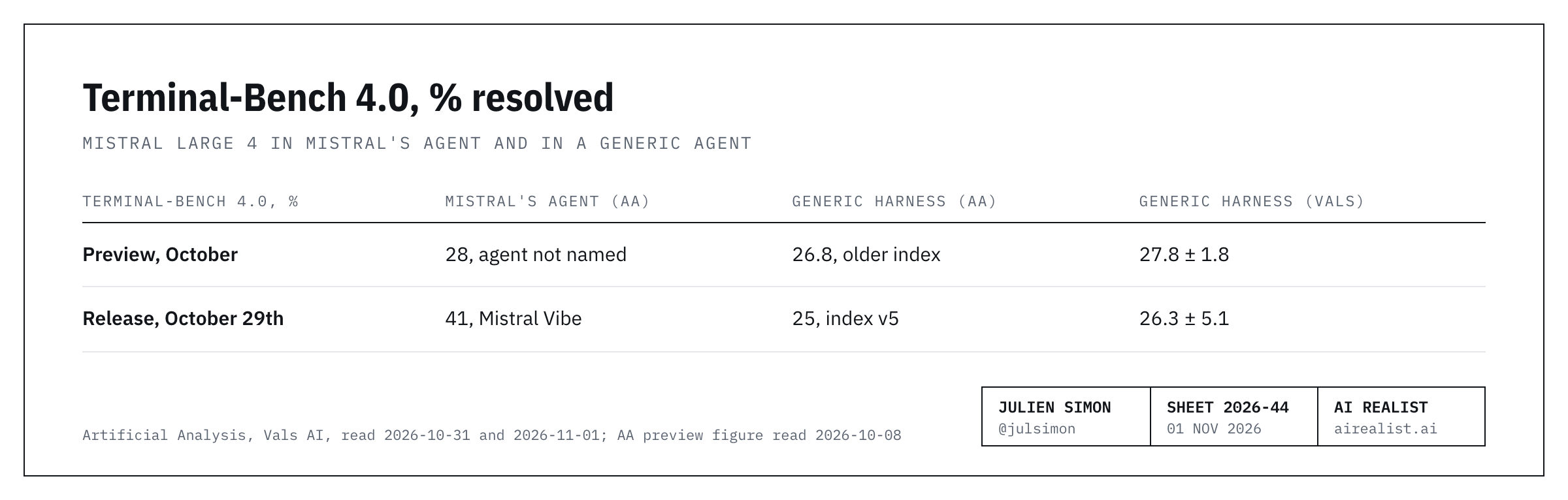
Outside Vibe, neither board sees a Terminal-Bench gain: Vals's 1.5-point drop sits well inside its margin, and AA's preview figure comes from an older index. Both generic runs used High effort, like the 41.[9][7]
What does a coding agent add to a Terminal-Bench score?
I call the difference between a model's score in its own agent and in mini-swe-agent its agent premium, in points. AA's two indexes give it for thirteen models.[9][4]
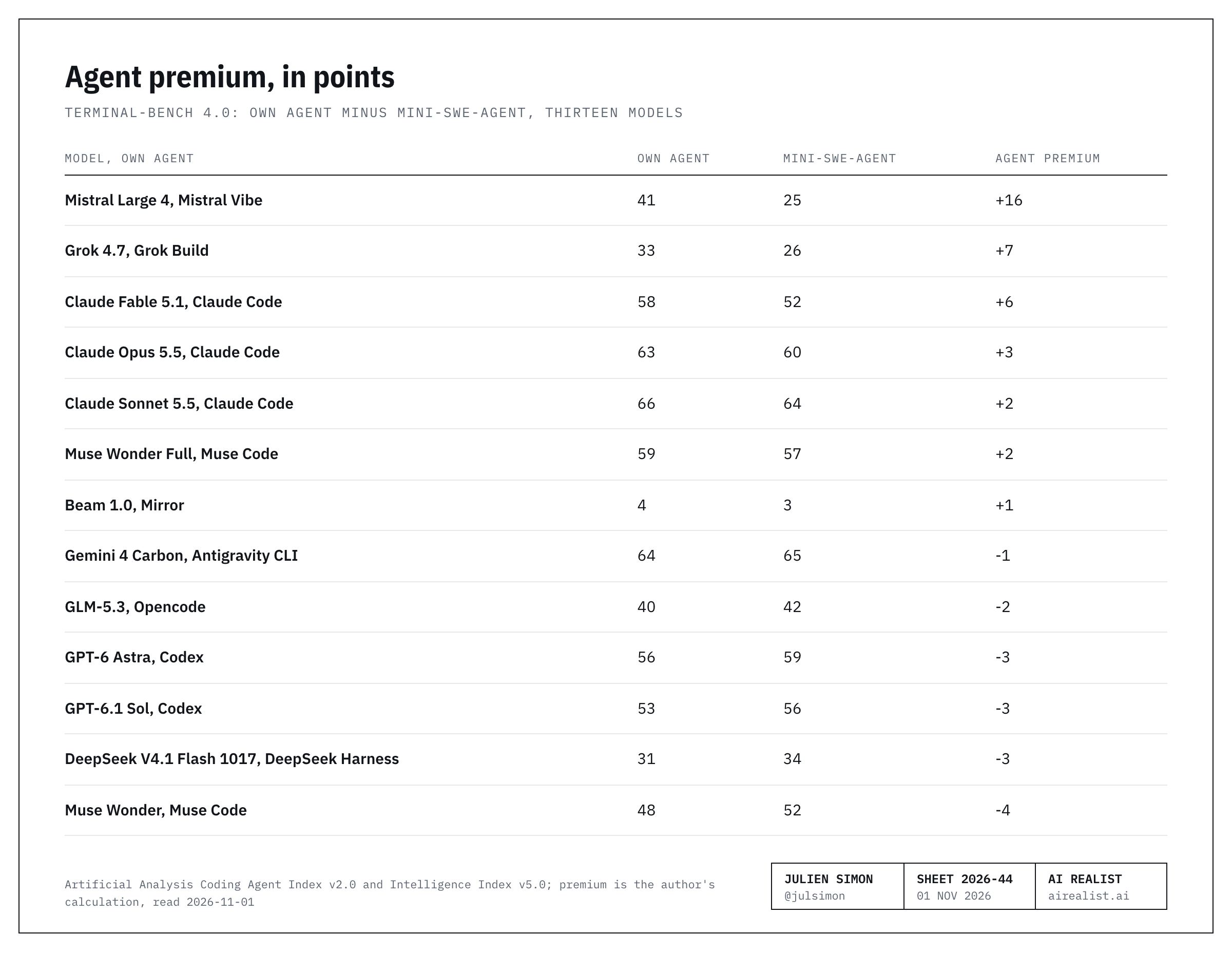
Large 4's agent premium is +16 points. The other twelve sit between -4 and +7, median 0. A harness alone can move a score by nine points: the StateM preprint lifts GPT-5.5 from a reference 83.1% to 92.1% on Terminal-Bench 2.1 with no change to the weights.[10] Vals prints plus or minus 5.1 points on Large 4's release score, so a premium of 5 or 7 can be noise, and 16 is hard to call noise. The best case against: both boards run mini-swe-agent, so a penalty that harness puts on Mistral's tool format would produce this table. But if the 28 was an agent run, a fixed penalty would have shown at preview. It did not: AA's agent score minus Vals's generic score was about 0 then and is about 15 now.[5]
On the Coding Agent Index's Terminal-Bench bars, the lead among open-weight models is 41 against 40 for GLM-5.3 in Opencode: one point, each model in its own agent. In mini-swe-agent, GLM-5.3 leads by 17: 42 against 25. GLM-5.3 scores 41.8 in Claude Code on the Terminal-Bench leaderboard: three agents, all within two points. Large 4 has been measured in two.[9][4][11]
What do you get with the Mistral Large 4 weights?
You get the weights. Vibe, Mistral's harness, is a separate download: it ships under Apache 2.0, and a config file sets the model provider.[11] No published run shows whether it gives 41 on weights you host: the Terminal-Bench leaderboard has no Mistral row.
Three readings fit the 13 points, and the data cannot tell them apart. Mistral credits "three weeks of additional reinforcement learning", reports gains beyond coding, and does not name its training tasks.[2]
The RL used agent tasks shaped like Vibe's, so the model gained a skill that does not transfer to a minimal agent.
The harness improved or sets the model up differently, with a different thinking budget or sampling: Vibe went from version 2.26 on October 6th to version 3.0 on October 19th, and AA's data records Vibe 3.0 for the 41, while the 28 names no version. Vibe at Medium effort scores 26.26, level with the generic runs.[12]
Both. A run outside Vibe at 38 or more would put the gain in the weights; at 25 to 30, in Vibe or in training on it.
Mistral Large 4's modified MIT license, read
Mistral's post calls the license a modified MIT with one condition.[13] It applies if you or any affiliate operates a "Model as a Service" business: giving a third party access to the weights or a derivative, for inference or post-training, with "meaningful control over the inputs, parameters, or training data". Any commercial use then needs a license from Mistral. Out of scope: "end-user products with model capabilities solely embedded within specific features or harnesses", and mere relaying.
My reading of the text: an inference platform is in. So is a consultancy that hands a client an endpoint on fine-tuned weights, because the client controls the inputs, or lets the client fine-tune them.
Kimi K3's license has the same Model as a Service definition and exclusions, but applies it only above $20 million of revenue over twelve months, and the remedy is a separate agreement with Moonshot. GLM-5.3's applies above $10 billion, and the remedy is a security review by Z.AI, not a license. DeepSeek V4.1 Flash is plain MIT.[14] Mistral's has no revenue floor. Of the four licenses, Mistral's reaches the most businesses.
Mistral Large 4's configuration file, opened
Large 3's configuration matched DeepSeek-V3's width, depth, and attention settings.[15] Large 4's does not: 6,144 wide against 7,168, 72 layers against 61, experts 6,144 wide against Large 3's 4,096, a different vocabulary.[16][15] It keeps DeepSeek's designs: latent attention, a shared expert and a sparse-attention indexer.
Mistral Large 4 against my October 9th marks
On October 9th I set three marks for October 31st: public weights, a permissive license file, and 38 or more on Artificial Analysis. The weights are public, and the license carries one condition. We can't score the third because AA changed its index in October. I also listed three things a buyer needs. The license is out and, by Mistral's account, so is a better checkpoint; the token count is still missing. The Terminal-Bench figure I flagged as the one mismatch has an explanation: Mistral's launch footnote credited its 28.3% to AA's coding index, an agent run, while the boards' figures came from a generic harness.[15]
Two things would settle it: an independent run of the released weights in a non-Mistral agent, or a technical report that names the setup behind the 28 and the 41.
Until then, when a lab hands you a benchmark, ask which agent was driving.
Notes
[1] Hugging Face commit history of mistralai/Mistral-Large-4-1T-A52B, read 2026-10-31: "Initial release", 2026-10-29 14:11:16 UTC; two README edits followed at 14:28 and 14:51. commit history
[2] Mistral, "Mistral Large 4 (Le Chonk) is now open weight", read 2026-10-31: the quoted sentence; the chart headed "Artificial Analysis Coding Agent Index - Terminal-Bench 4.0" with bars "ML4 Preview - self reported" 28 and "Mistral Large 4" 41; "A full technical report is coming soon." Mistral release post Second document: Artificial Analysis, Coding Agent Index v2.0, Terminal-Bench 4.0 tab, text saved 2026-11-01, which lists "Mistral Vibe - Mistral Large 4 (High)" and a Terminal-Bench 4.0 bar of 41. AA Coding Agent Index
[3] GitHub repository data, read through the GitHub API on 2026-11-01: mistral-vibe 5,268 stars; opencode 223,729; claude-code 154,130. Stars measure attention, not use. The release post's closing section names the stack: Mistral release post ("Get started in Mistral Studio, through the Mistral API, or on OpenRouter"; Mistral Forge; "try the new model in Vibe Code").
[4] Artificial Analysis, Coding Agent Index v2.0, Terminal-Bench 4.0 tab, read 2026-10-31 by screenshot and zoom. AA Coding Agent Index Second document for the peers: the chart on Mistral's release page, which prints 41, 40 (GLM-5.3), 31 (DeepSeek V4.1 Flash 1017), 21 (Kimi K3) and 3 (Beam 1.0; AA's page prints 4). Mistral release post Premium is the Coding Agent Index score minus the Intelligence Index score (note 9). The Intelligence Index bars were paired with models by bar order, because the chart's labels are rotated and overlap; the own-agent column was checked against Mistral's chart for GLM-5.3, DeepSeek, Beam and Mistral. GPT-6.1 Terra (xhigh in one chart, max in the other) and Kimi K3 (K3.1 Pro on the Intelligence Index) are left out.
[5] Preview attribution. Mistral's preview page, capture of 2026-10-06 13:26 UTC, footnote: "Scores on DeepSWE, Terminal-Bench 4, and SWE Atlas QnA use the numbers reported by the ArtificialAnalysis coding index"; absent from the 14:42 UTC capture and the live page. preview page, October 6th capture The preview chart's footnote, our capture of 2026-10-08: "Scores use the numbers evaluated privately by Artificial Analysis ahead of the harness' public launch". preview page, October 8th capture AA's coding page listed no Mistral model on 2026-10-08 (our capture), and the preview page named no agent. AA Coding Agent Index Reported, not confirmed: these are Mistral's attributions; AA published no preview row. The gap of about 0 then and about 15 now is my calculation: 28 minus Vals's 27.78 is 0.2; 41 minus Vals's 26.26 is 14.7, AA agent figures against Vals's generic ones.
[6] Artificial Analysis, Intelligence Index methodology, read 2026-10-31: Terminal-Bench 4.0 in mini-swe-agent, full 66-task dataset, three repeats, 500-step cap. AA methodology Second document: Vals AI's Terminal-Bench 4.0 page, read 2026-10-31: "All models were benchmarked using mini-swe-agent, a minimal, model-agnostic agent harness"; 66 tasks, three runs per model. Vals Terminal-Bench 4.0
[7] Vals AI, "Mistral Large 4 OSS" (article of 2026-10-29: temperature 1, top_p 0.95, high reasoning effort, 256k output cap; 26.26% plus or minus 5.13) and the preview entry (27.78% plus or minus 1.82), read 2026-10-31. Vals, Large 4 OSS Vals, preview entry The preview entry read 22.727% plus or minus 0.875 on 2026-10-08 (our capture; harness named Mini-SWE-agent). Its "View Hyperparameter Settings" panel, opened 2026-10-31, lists temperature 1, top P 0.95, top K default, 256,000 max output tokens and high reasoning effort, and no note on what changed. Second document for the absence of a gain outside the agent on Terminal-Bench: the AA figure in note 9.
[8] Mistral Large 4 model card on Hugging Face, read 2026-10-31: sampling advice (temperature 1.0, top_p 0.95); "On the Artificial Analysis Coding Agent Index, ML4 scores 48%, effectively tied with the leading open-weight model, GLM-5.3". model card
[9] Artificial Analysis, Terminal-Bench 4.0 evaluation page, text saved 2026-11-01: "We run all 66 Terminal-Bench 4.0 tasks with the mini-swe-agent harness"; Mistral Large 4 (high) 24.7%, rounded to 25 in the table, and GLM-5.3 41.9%, rounded to 42. AA Terminal-Bench 4.0 page The model page gives 26 on the Intelligence Index. AA model page AA's preview figure of 26.8% is from our capture of 2026-10-08, from the Intelligence Index before the v5 change of October 2026, so it does not compare with the 25. AA's version history puts Terminal-Bench 4.0 in mini-swe-agent from version 4.3, September 2026: AA methodology Second document: Vals AI, "Mistral Large 4 OSS", 26.26% on the same benchmark. Vals, Large 4 OSS
[10] Qin et al., "StateM: Reaching 95.3% Raw Accuracy, or a $15 Frontier Run, on Terminal-Bench 2.1 via Harness Scaling", arXiv 2608.15089, August 2026, read 2026-11-01 (abstract). A preprint, not peer reviewed, on Terminal-Bench 2.1 and not 4.0, and the comparison is the authors' own against a reference score; the abstract does not say which harness produced the 83.1% reference; its leaderboard submission was unmerged when the capture was made (our file sources/2026-08-15-statem-harness-scaling-terminal-bench.md).
[11] Mistral Vibe, repository README, read 2026-10-31: "Mistral's open-source CLI coding assistant"; "Customize models, providers, tool permissions, and UI preferences through a simple config.toml file"; license Apache 2.0. Mistral Vibe repository Second document: the model card, "we recommend Mistral Vibe, our coding agent powered by Mistral Large 4". model card The Terminal-Bench 4.0 leaderboard, text saved 2026-11-01, lists 35 rows for 23 models and none for Mistral; GLM-5.3 in Claude Code: 41.8% ± 3.2. Terminal-Bench leaderboard
[12] Mistral Vibe releases, read through the GitHub API on 2026-11-01: release list, v2.26.0 published 2026-10-06 and v3.0.0 published 2026-10-19. The release notes list product features and make no benchmark claims. AA's page data, read 2026-11-01, records agent version 3.0.0-v14 for the Large 4 Terminal-Bench 4.0 run (Mistral Vibe with Large 4 at High effort); the preview's 28 names no version. The same page data lists Vibe with Large 4 at Medium effort at 26.26 and at High effort at 41.41 on Terminal-Bench 4.0.
[13] LICENSE file of the repository, read from the raw file 2026-10-31. Section 3 exempts internal use and use of the model accessed through Mistral's official products. LICENSE Second document: the model card's one-line summary of the same license. model card "My reading" is mine and not legal advice.
[14] Kimi K3, GLM-5.3 and DeepSeek V4.1 Flash 1017 LICENSE files, read from the raw repository files 2026-11-01: Kimi K3 license, section 2 (20 million US dollars over any consecutive 12 months; a separate agreement with Moonshot AI); GLM-5.3 license (10 billion US dollars over any consecutive 12 months; Z.AI's security review); DeepSeek V4.1 Flash 1017 license (MIT License). Second document for the Mistral comparison: note 13. "My reading" of how the three compare is mine and not legal advice.
[15] Julien Simon, "Skill Issue", The AI Realist, 2026-10-09: the three things a buyer needs; the Terminal-Bench exception; "Three different models can share the same name"; the three marks for October 31st; the configuration-file comparison. Skill Issue
[16] config.json of the repository, read 2026-10-31, against the files of DeepSeek-V3 and DeepSeek-V3.2-Exp. Large 4 config.json DeepSeek-V3 config.json DeepSeek-V3.2-Exp config.json Shared with V3: key-value rank 512, 64 rotary dimensions, 128-wide value heads. Differs: 64 against 128 non-rotary dimensions; no query compression field (V3: 1,536); indexer 32 heads against V3.2-Exp's 64, with head width 128 and top-k 2,048 shared; vocabulary 204,800 against 129,280. Layers 39 to 71 in steps of four reuse layer 35's cache; rotary encoding is dropped on every fourth layer from layer 3. The card says "trained from scratch" and does not mention DeepSeek. model card The full table is in data/config-deep-dive.md. Large 3's values are from my comparison of 2026-10-08, in the notes of the earlier piece.