

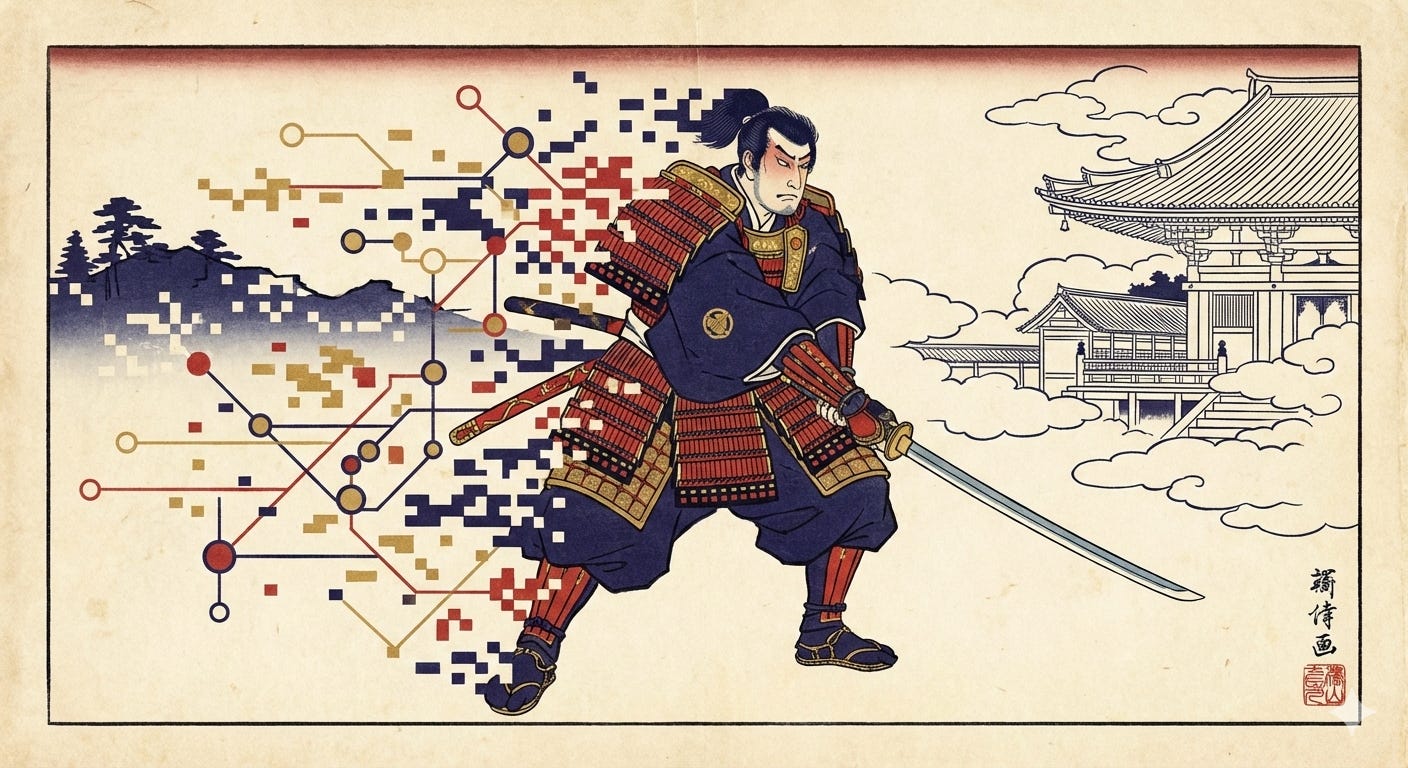
On January 21, 2025, Masayoshi Son stood next to Donald Trump in the White House, announcing Stargate — a $500 billion AI infrastructure project, the largest in history [1]. Son would serve as chairman. The money would build data centers in Texas, Ohio, New Mexico, and Wisconsin. SoftBank’s commitment: $41 billion to the Stargate venture, financed partly through $10 billion borrowed from Mizuho — a Japanese megabank [2]. To fund it, Son sold his entire NVIDIA stake for $5.83 billion [3].
The world’s largest AI bet was made by an outsider, with Japanese bank money, for American infrastructure.
Son was born in 1957 to zainichi Korean parents in Saga Prefecture. He grew up in a shantytown built illegally on Japan National Railways property [4]. His father raised pigs and brewed illegal sake. The family used the Japanese surname Yasumoto to avoid the discrimination that has shadowed Korean-origin communities in Japan since the colonial period. Son experienced severe bullying as a child and has spoken publicly about contemplating suicide [5]. He left Japan at 16 for California, studied at UC Berkeley, returned, reclaimed his Korean surname, and built SoftBank into the country’s most important technology company — while remaining, as the Financial Times put it, “distrusted by Japan’s corporate elite, chiefly because of his ethnic Korean background” [6].
Seven months before Stargate, in Tokyo, a different kind of outsider story was unfolding. Sakana AI — founded in 2023 by Llion Jones, a Welsh co-author of the Transformer paper that ignited the entire AI revolution, and David Ha, an American former Google Brain researcher — had raised $479 million at a $2.65 billion valuation, making it Japan’s highest-valued AI startup [7]. Their Japanese co-founder, Ren Ito, was himself an outlier: an ex-diplomat, former speechwriter for Prime Minister Abe, and early employee at Mercari, Japan’s first tech unicorn [8]. Not a product of the corporate generalist pipeline.
Japan’s two most significant contributions to the global AI race are run by people its system either excluded or imported. That tells you everything about why the world’s third-largest economy — with the engineering culture that built the Shinkansen, the robotics industry that automated global manufacturing, and $65 billion in government AI commitments — has not produced a single frontier-scale AI model [9].
The Gap
The numbers are stark and strange. Japan’s government has pledged ¥10 trillion ($65 billion) through 2030 for AI and semiconductor development, with ¥2 trillion ($13.2 billion) allocated for 2024-2025 alone [10]. Private investment tells a different story: Japan’s total private AI investment was $0.93 billion in 2024, according to the Stanford AI Index [11]. The UK — with an economy roughly half the size of Japan’s — invested $4.5 billion. The United States invested $109.1 billion [12].
Japan ranks ninth globally on Stanford’s AI Vibrancy Tool, behind not just the US and China but also India, South Korea, the UK, Singapore, and Spain [13]. It has 11 unicorn startups. The US has over 700 [14]. The country that leads the world in industrial robotics, precision manufacturing, and materials science is, in the field that will define the next quarter-century, a second-tier player spending first-tier money.
The gap between inputs and outputs is inexplicable unless you understand the system producing them.
The Doom Loop
Japan’s AI problem is not a resource problem. It is not a policy problem. It is a system problem, and the system is a doom loop.
It begins with how Japan builds its workforce. The lifetime employment model — shūshin koyō — remains the structural backbone of corporate Japan. Employees are hired as generalists, rotated across departments, promoted by seniority, and rewarded for loyalty [15]. The OECD has specifically noted that this produces “generalist workers without specific areas of expertise” [16]. Frontier AI research requires precisely the opposite: obsessive specialization, years of depth in narrow domains, and the willingness to bet a career on an unproven technical direction. The system is architecturally mismatched.
The few specialists it produces can’t stay. Japan’s Ministry of Health, Labour and Welfare reports an average software engineer salary of ¥5.69 million — roughly $38,000 [17]. The US Bureau of Labor Statistics reports a median of $133,080 for the same role [18]. That is a 3.5x gap (the Japanese figure is an average; the median would likely widen the gap further). For top-tier AI researchers, the disparity is even greater: a senior machine learning engineer at Google Brain or DeepMind earns multiples of what the same person would earn at any Japanese institution. The pull is constant and structural.
The pipeline cannot refill because demographics are terminal. Twenty-nine percent of Japan’s population is 65 or older, the highest proportion of any major economy [19]. The birth rate hovers around 1.2 [20]. The working-age population will shrink by 24 million by 2050 [21]. METI projects a shortfall of 590,000 IT workers by 2030 [22]. There are not enough young people entering the system to replace those leaving it, let alone to staff the kind of frontier research labs that employ thousands of PhD-level specialists.
Immigration cannot compensate at the necessary scale. Foreign workers reached a record 2.3 million in 2024, and the government has loosened visa rules [23]. But integration is slow, and the barriers are structural, not merely bureaucratic. Japanese is linguistically distant from English. The writing system uses three scripts. Most of corporate Japan operates overwhelmingly in Japanese [24]. And the language gap is getting worse, not better. On the EF English Proficiency Index, Japan has fallen for eleven consecutive years, dropping to 96th out of 123 countries in 2025 — tied with Afghanistan and classified as “very low proficiency” [25]. The most alarming detail: Japanese adults aged 18-25 now score lower than those aged 26 or older [26]. The generation that would need to collaborate with global AI researchers is less equipped to do so than their parents were. Japan is not hostile to foreigners — Sakana AI’s existence proves that — but it is not designed to absorb them at the rate frontier AI would require, and the linguistic bridge is collapsing rather than forming.
Risk-taking is culturally penalized in measurable ways. The Global Entrepreneurship Monitor found that only 31% of working-age Japanese adults see starting a business as a desirable career choice, compared to 55% across innovation economies [27]. Among those who see good opportunities, 55% say they would not act on them for fear of failure [28]. An academic study using GEM data from 2001-2018 found that just 3.4% of Japanese adults were involved in entrepreneurship — the lowest of any country in the dataset [29]. Failure in Japan carries a social stigma that is qualitatively different from Silicon Valley’s “fail fast” ethos. The system rewards those who do not fail, which means it rewards those who do not try.
This is a causal chain, not a list of problems. Generalist culture produces the wrong kind of talent. Low salaries drive specialists abroad. Demographics shrink the pipeline. Immigration can’t backfill. Risk aversion prevents alternatives from forming. Each link reinforces the next. And at the end of the chain, the only people willing and able to operate at frontier scale are outsiders that the system either excluded or imported.
What the System Builds
Strip out SoftBank and Sakana AI. What does Japan’s institutional AI effort actually look like?
It looks like an enterprise deployment. Fujitsu, NEC, NTT, and Hitachi have each built Japanese-language AI platforms for domestic industrial customers [30][31][32]. These are real products serving real customers, and none of them is frontier research. They are applying other people’s breakthroughs to Japanese industry — useful work, but the same value chain position that India’s TCS and Infosys occupy for Western clients. Japan’s corporate AI adoption rate — 78% of companies, among the highest globally [33] — suggests the deployment strategy is working. But deployment without indigenous capability is dependency — and AI dependency is unlike chip dependency, because models can be withheld via API, degraded for foreign users, or updated unilaterally in ways that physical hardware cannot. Every major technology power depends on someone else for something — the US depends on TSMC for advanced chips, and Europe depends on ASML for lithography. But the US controls the model layer, which is where capability originates. Japan does not. In a geopolitical environment where AI supply chains are increasingly weaponized, that dependency has national security costs that adoption metrics do not capture.
The robotics story follows the same pattern in physical form and is more revealing because robotics is supposed to be Japan’s domain. Japan manufactures 46% of the world’s industrial robots [34]. Fanuc, Yaskawa, Kawasaki, Mitsubishi, Denso — half the global top ten are Japanese companies [35]. The country has 450,500 operational industrial robots, the second-largest installed base on earth [36]. This is genuine, earned dominance built over decades.
But Japan’s robots are industrial robots: pre-programmed machines in controlled factory environments. They weld car frames. They paint chassis. They place components on circuit boards. Every variable is known, every motion is scripted, and none of it requires AI. The robots Japan dominates are the robots that don’t think.
What Japan’s demographic crisis actually demands is a different kind of robot entirely — service robots, humanoid caregivers, autonomous systems that can navigate unstructured human environments where nothing is scripted. Care homes where elderly patients move unpredictably. Hospitals where every interaction is different. Homes where a robot must understand speech, interpret emotion, and make real-time decisions about physical contact with fragile human bodies. These robots require frontier AI: computer vision, natural language processing, and adaptive decision-making. The technology Japan cannot build is the technology it most urgently requires for survival.
The gap between need and capability is measurable. Japan’s nursing sector has one applicant for every 4.25 open positions [37]. The Ministry of Health projects a shortfall of 380,000 care workers [38]. AIREC, Waseda University’s AI-driven humanoid caregiver prototype, can roll a patient onto their side to prevent bedsores — but it weighs 150 kilograms, costs an estimated ¥10 million ($67,000), and will not be ready for deployment until 2030 [39]. SoftBank’s Pepper, the most famous Japanese humanoid robot, was trialed in nursing homes and became a case study in failure: it required constant Wi-Fi, malfunctioned regularly, and created more work for caregivers than it saved [40]. (Full disclosure: I was Software CTO at Aldebaran Robotics, the French company SoftBank acquired to build Pepper. My team launched the robot under intense pressure to ship hardware before the software was ready — a dynamic that captures, in miniature, the mismatch this entire piece describes [41].) The country that builds nearly half the world’s factory robots cannot build a robot that can reliably care for its aging population because reliable care requires the AI that Japan’s system has not produced.
The government’s flagship AI effort reveals the deeper problem. Fugaku-LLM, Japan’s most prominent domestically developed model, is a GPT-2 model with 13 billion parameters. It was built by a six-institution consortium and trained on the Fugaku supercomputer, which runs on ARM-based CPUs rather than the NVIDIA GPUs that power virtually all frontier AI training globally [42]. The project required years of painstaking work to port deep learning frameworks to hardware that was never designed for it. The result is the highest-scoring open model trained entirely on Japanese-origin data on the Japanese MT-Bench [43]. It is also roughly the size that well-funded startups treat as a test run.
Larger Japanese models do exist. SoftBank’s SB Intuitions, Preferred Networks, and the National Institute of Informatics have all produced models in the 70-100 billion parameter range, with SB Intuitions’ largest using a mixture-of-experts architecture [44][45][46]. None approaches frontier scale and none has achieved global competitive significance. Preferred Networks comes closest to an indigenous exception: founded by University of Tokyo researchers, funded domestically, building serious AI for industrial applications. But even PFN’s ambitions are sub-frontier, and its primary market is Japanese manufacturing — optimization and robotics, not foundation models. The gap between Japan’s largest models and the frontier is not a gap that incremental progress closes.
FugakuNEXT, the successor to the Fugaku supercomputer, is planned for 2030 with a budget exceeding $750 million and will finally integrate NVIDIA GPUs [47]. RIKEN’s new systems, with 2,140 Blackwell GPUs, are expected to be operational by spring 2026 [48]. METI has awarded ¥72.5 billion to five companies for the development of AI supercomputers, with SAKURA Internet receiving the largest allocation [49]. Its GENIAC program — the Generative AI Accelerator Challenge — has funded development of multiple domestic foundation models, though none have reached global competitive scale [50]. These are real commitments. They are also five to ten years behind where the frontier moved during the time it took to plan them. The system is built by consensus, and consensus takes time that the AI race does not offer.
Japan’s AI Bill, passed in 2025 as the country’s first comprehensive AI legislation, creates an AI Strategy Headquarters but — in characteristically Japanese fashion — “does not impose direct obligations on businesses at this stage” [51]. It is a framework for eventual action. Frontier AI was built by people who acted before frameworks existed.
The Outsiders
SoftBank complicates the story, and it is worth being honest about how.
Son is not ignoring Japan. SoftBank Corp. — the domestic subsidiary — has invested roughly ¥150 billion ($960 million) in Japanese AI computing infrastructure [52]. It acquired Sharp’s Sakai Plant for ¥100 billion to build a “Brain Data Center” [53]. It is constructing one of Japan’s largest AI data centers in Hokkaido [54]. It has launched a sovereign cloud initiative with Oracle and is converting its 5G base stations into distributed AI inference nodes through an AI-RAN architecture that NVIDIA estimates can generate $5 in revenue for every $1 of capex [55].
However, scale tells the story. SoftBank’s domestic AI infrastructure investment totals roughly $1.6 billion. Its commitment to Stargate and OpenAI exceeds $41 billion. For every dollar SoftBank invests in Japan’s AI infrastructure, approximately twenty-five go to the United States [56]. The explanation is not that Son dislikes Japan. It is that the US ecosystem — its talent density, risk tolerance, regulatory speed, and capital markets — can absorb frontier-scale investment in a way Japan’s cannot. Son said it himself: “If I had stayed all the time in Japan, I probably would have become much more conservative, just as other Japanese” [57].
Sakana AI’s model is different and, in some ways, more instructive. Jones and Ha did not choose Tokyo despite its limitations. They chose it because of its unsolved problems — a linguistically isolated market, a rapidly aging society, a corporate sector desperate for AI-driven productivity, and a culture whose complexity no American foundation model handles well [58]. Their strategy is explicitly post-frontier: they do not attempt to compete with OpenAI or Anthropic on model scale. Instead, they use nature-inspired model merging techniques to produce specialized systems for Japanese enterprise customers [59]. MUFG, Daiwa Securities, and defense contractors are early partners [60].
This is a viable business. It may be the right strategy for Japan. But it is also an acknowledgment: Japan is a market for AI, not a source of it. The frontier is built elsewhere. Japan’s role is adaptation and deployment.
The Mirror
Readers of my earlier piece on India will recognize a mirror here — two opposite failure modes producing the same result [61]. India’s paradox: the country graduates five million STEM students a year, supplies engineers to every major AI lab on earth, and has not produced a globally competitive frontier model, because the system is optimized to export talent rather than retain it.
India’s system produces world-class AI talent and then loses it — the incentive structure optimizes for export. Japan’s system does not produce any talent. The generalist pipeline, salary compression, demographic collapse, and cultural risk aversion — these are not bugs in Japan’s AI strategy. They are features of Japan’s social contract that are incompatible with what frontier AI demands. India’s paradox is an abundance that flows outward. Japan’s institutional strength is misdirected.
The comparison sharpens at the startup level. India’s most promising AI company, Sarvam AI, was founded by two IIT Madras researchers — products of India’s own system — who chose to build domestically on government-subsidized compute [62]. Japan’s most promising AI company was founded by two foreign researchers who chose Tokyo for its problems, not its ecosystem. India’s system produces the founders and loses them. Japan’s system needs to import them.
Both countries rank behind the US, China, and each other on various AI metrics. Both have massive government commitments. Both have genuine strengths — India in talent, Japan in infrastructure and institutional capital. Neither has produced a globally competitive frontier model. They are two different proofs of the same uncomfortable truth: having some of the ingredients is not the same as having the recipe.
The Meiji Question
The obvious objection is that Japan has never accepted permanent technological dependency, and it is not about to start now. The pattern is consistent across 150 years: during the Meiji Restoration, Japan imported Western experts — the oyatoi gaikokujin — sent students abroad, built indigenous capability within a generation, and then dismissed the foreigners [63]. In the postwar decades, Japan took advantage of American technology transfers and built Toyota, Sony, and Honda into global leaders within 25 years. When semiconductors became strategic, MITI’s VLSI project consolidated five rival companies into a single research consortium that dominated global DRAM within a decade [64]. When the United States forced the 1986 Semiconductor Agreement to cap Japan’s market share, it was because the sovereignty playbook had worked too well [65].
The current spending looks exactly like previous sovereignty pushes. Rapidus, the $7 billion chip consortium, is building Japan’s first cutting-edge 2nm fab in Hokkaido [66]. FugakuNEXT will finally integrate NVIDIA GPUs. SAKURA Internet is scaling from 2,000 to 10,800 GPUs on government funding. SoftBank’s sovereign cloud and AI-RAN architecture are explicitly domestic infrastructure plays. METI knows this playbook. It has run successfully multiple times.
The question is whether AI is the first strategic technology for which the Meiji playbook breaks down.
Every previous sovereignty win shared two features that the current moment does not. First, they happened during a demographic tailwind. When MITI ran the VLSI project, Japan’s working-age population was growing. There were surplus engineers to absorb into new industries. The pipeline could be redirected. Today, the pipeline is shrinking by 24 million people, and the few specialists it produces are pulled abroad by a 3.5x salary gap. Second, every previous win was due to hardware and manufacturing problems — Japan’s structural strength. Chips, cars, trains, cameras: these reward precision, reliability, incremental improvement, and cross-functional coordination. Lifetime employment, salary compression, generalist rotation, consensus governance — each of these is load-bearing in Japan’s social contract, and each was an asset in hardware-era sovereignty pushes.
Frontier AI is fundamentally a talent-and-software problem. It rewards obsessive specialization, concentrated risk, and the willingness to fail spectacularly — and each of those same load-bearing features selects against it. This is not merely a theoretical concern. Japan has never — whether by choice or by structure — produced a globally significant software platform — no operating system, no cloud infrastructure, no search engine, no enterprise software company of global scale.
Every Japanese technological triumph, from the Shinkansen to ASIMO, has been a hardware achievement. Honda’s famous humanoid robot was a masterpiece of servo engineering and actuator design whose “intelligence” was entirely pre-programmed motion sequences; Honda shut it down in 2022 without ever solving the adaptive intelligence problem that frontier AI now addresses. The Meiji playbook has been tested exclusively on hardware, and AI is the most software-intensive strategic technology in history. You cannot rotate a generalist through the LLM training division for two years and expect frontier results.
This suggests a three-layered outcome. Deployment sovereignty — controlling how AI is used in Japanese industry — is achievable and is already underway. SAKURA Internet, NTT’s sovereign cloud, SoftBank’s domestic data centers, and the AI-RAN network are real infrastructure that will keep Japanese enterprise AI on Japanese soil. Specialized model sovereignty — Japanese-language models, domain-specific systems for finance and manufacturing, regulatory-compliant AI — is partially achievable, especially if Japan continues to attract foreign founders like Jones and Ha who want to solve Japanese problems. This is the Meiji playbook adapted: import the researchers, build around them, and eventually develop indigenous capability.
Frontier sovereignty — training a model that competes with the next generation from OpenAI, Anthropic, or Google — is structurally blocked. It requires thousands of specialized researchers, tens of billions in concentrated risk capital, and an institutional willingness to fail at scale. The doom loop is specifically about this layer. And this is the layer where dependency is dangerous, because whoever controls the frontier models controls the capabilities that flow down to every other layer.
Japan will not be a digital colony. It will customize and deploy AI more effectively than almost any country on earth. But the country that built the Shinkansen, the Walkman, and the most reliable supply chains in history will not build a frontier AI model — not because it lacks money or ambition or engineering culture, but because its system selects for the exact traits that made all those achievements possible and against the exact traits that frontier AI demands. Every previous generation of strategic technology eventually yielded to the Meiji playbook: import, learn, master, surpass. AI may be the first where the mastery step requires breaking the system that made the playbook work in the first place.
That is not a failure of strategy. It is a structural reality, and the most consequential one Japan has faced since the Meiji Restoration.
Notes
[1] SoftBank Group, “SoftBank Group, OpenAI, Oracle and MGX Establish Stargate,” January 21, 2025. The Stargate joint venture involves SoftBank, OpenAI, Oracle, and MGX, with an initial investment commitment of $100 billion and plans to scale to $500 billion.
[2] Multiple sources, including Reuters and Nikkei Asia, report that Mizuho is financing SoftBank’s AI investments. SoftBank’s total OpenAI commitment includes both direct equity investment through Vision Fund 2 and additional financing arrangements. See also Wikipedia: Stargate LLC.
[3] CNBC, “SoftBank recently sold its entire Nvidia stake for $5.83 billion to make room for its investment in OpenAI,” November 11, 2025.
[4] Son’s biographical details are drawn from multiple sources, including the Financial Times, The Globalist, Next Big Idea Club, and the Yale Review of International Studies’ analysis of zainichi Korean communities in Japan. The characterization of the family’s living conditions appears consistently across authorized and unauthorized biographies.
[5] Son discussed childhood bullying and suicidal ideation in multiple interviews. The zainichi Korean community in Japan faced systemic discrimination, including housing restrictions, employment barriers, and social exclusion. The landmark Hitachi employment discrimination case (1970) documented how major Japanese corporations refused to hire ethnic Koreans — a practice that, while legally prohibited, persisted informally for decades.
[6] Financial Times profile of Masayoshi Son. The quote appears in Lionel Barber, Gambling Man: The Secret Story of the World’s Greatest Disruptor, Masayoshi Son. The “old man killer” characterization — referring to Son’s ability to win over senior Japanese businessmen individually while remaining an outsider to the institutional establishment — appears in multiple Japanese and English-language profiles.
[7] Sakana AI funding and valuation per TechCrunch and company announcements. Total raised includes a $300 million Series B round (September 2024) and prior rounds. Investors include MUFG, Khosla Ventures, In-Q-Tel (the CIA’s venture arm), Lux Capital, and NEA.
[8] Ren Ito’s background per company announcements and press profiles. Mercari, founded in 2013, was Japan’s first tech company to achieve unicorn status, making Ito’s early involvement notable as an exception to the mainstream corporate career path.
[9] Government AI commitment of ¥10 trillion per METI announcements and multiple reporting sources, including Nikkei Asia. “Frontier-scale” is defined here as models competitive with GPT-4, Claude, or Gemini — characterized by parameter counts exceeding one trillion, training runs costing $100 million or more, and performance at or near the global benchmark frontier.
[10] METI, fiscal year 2024-2025 budget allocations for AI and semiconductor development. The ¥10 trillion figure represents a multi-year commitment through 2030, with specific allocations including ¥1.05 trillion for next-generation chip and quantum computing research and ¥920 billion for the development of the Rapidus semiconductor factory.
[11] Stanford HAI, AI Index Report 2025. Japan’s private AI investment figure of $0.93 billion represents total private investment in AI companies headquartered in Japan.
[12] Stanford HAI, AI Index Report 2025, Economy chapter. US private AI investment grew to $109.1 billion in 2024 — nearly 12 times China’s $9.3 billion and 24 times the UK’s $4.5 billion.
[13] Stanford HAI, Global AI Vibrancy Tool 2025. Rankings use expert-weighted indicators across eight pillars, including R&D, economy, infrastructure, education, diversity, responsible AI, policy, and public opinion. Top ten: United States, China, India, South Korea, United Kingdom, Singapore, Spain, UAE, Japan, Canada.
[14] Japan unicorn count per Tracxn (February 2026): 11 unicorns, including Sakana AI. US unicorn count per CB Insights and Hurun Global Unicorn Index 2025: approximately 700-758, depending on methodology and date. Japan’s government Five-Year Startup Plan targets 100 unicorns by 2027.
[15] The lifetime employment system (shūshin koyō) has weakened but remains the structural norm at large Japanese corporations. The Ministry of Health, Labour and Welfare’s annual surveys consistently show that the majority of large-firm employees remain with a single employer throughout their careers, and inter-company mobility remains low by OECD standards.
[16] OECD economic surveys of Japan have repeatedly noted the generalist workforce structure. The specific characterization of “generalist workers without specific areas of expertise” reflects OECD analysis of Japan’s human resource development patterns and their implications for innovation capacity.
[17] Japan Ministry of Health, Labour and Welfare, Wage Structure Basic Statistical Survey 2024. Average annual compensation for “software creators” (defined as those engaged in specification determination, design, and programming): ¥5.69 million. This figure rose from ¥4.8 million in 2020 — a 12.5% increase that still leaves a substantial gap with US equivalents.
[18] US Bureau of Labor Statistics, Occupational Employment and Wage Statistics, May 2024. Median annual wage for software developers (SOC 15-1252): $133,080. Mean hourly wage: $63.98.
[19] Statistics Bureau of Japan, Population Estimates. Japan’s proportion of population aged 65 and over is the highest among major OECD economies.
[20] Japan’s total fertility rate has declined steadily. Government statistics for 2024 show the rate at approximately 1.2, well below the 2.1 replacement level.
[21] National Institute of Population and Social Security Research projections. The working-age population (15-64) is projected to decline from approximately 74 million to 50 million by 2050.
[22] METI, “IT Human Resources Supply and Demand Survey,” projects shortfalls under various demand scenarios. The 590,000 figure represents the medium-growth scenario.
[23] Japan Ministry of Justice, Immigration Statistics 2024. The number of foreign workers in Japan reached a record 2.3 million. The government has expanded the Specified Skilled Worker visa program and other pathways, but total participation in the foreign workforce remains modest compared to most OECD economies.
[24] The linguistic barrier is structural, not merely practical. Japanese uses three writing systems (hiragana, katakana, kanji) and is classified as a Category IV language by the US Foreign Service Institute — the most difficult category for English speakers, requiring approximately 2,200 class hours to achieve proficiency.
[25] EF Education First, English Proficiency Index 2025 (based on 2024 test data from 2.2 million test-takers across 123 countries). Japan ranked 96th, tied with Afghanistan, classified as “very low proficiency” — the lowest tier. Japan has fallen in every edition since the index began in 2011, when it ranked 14th out of 40 countries. See also SoraNews24 coverage and Nippon.com analysis. EF noted that proficiency among young adults aged 18-25 has not recovered post-COVID, with more countries seeing further declines for this cohort.
[26] Japan’s nationwide academic achievement test results, reported by SoraNews24 and NHK. Over half of the students scored 0% on the English-speaking section. Under 35 percent of middle school English teachers met the government’s CEFR B2 proficiency benchmark, according to MEXT survey data. The 18-25 age cohort scoring below the 26+ cohort was reported in the 2024 EF EPI analysis (based on 2023 data, released November 2024).
[27] Global Entrepreneurship Monitor. Japan’s last full participation in the GEM Adult Population Survey was 2022; the 31% figure for entrepreneurship as a desirable career choice represents the most recent available data. For context, the global average across innovation-driven economies in 2024 was approximately 55%.
[28] GEM data. The fear-of-failure rate is the percentage of adults who see good business opportunities but do not act because of fear of failure. Japan’s rate of 55% compares with a global average that had risen to 49% by 2024 — meaning Japan was six percentage points above today’s global norm even when the data were collected.
[29] Springer Nature, “Decomposition analysis of entrepreneurial activities in Japan: An international comparison,” Journal of Global Entrepreneurship Research (2023). Using GEM data from 2001-2018 across multiple economies, Japan recorded the lowest adult entrepreneurial activity at 3.4% — the lowest of any country in the dataset.
[30] NEC Corporation press materials, 2024-2025. The 928 A100 GPU installation represents Japan’s largest corporate AI research supercomputer.
[31] NTT Corporation, Tsuzumi 2 product announcements. The lightweight design philosophy — explicitly targeting single-GPU deployment — reflects NTT’s enterprise strategy of efficient deployment over frontier scale.
[32] Hitachi, Ltd., corporate announcements. The ¥300 billion investment covers the broader digital transformation strategy, including but not limited to AI.
[33] Japan’s corporate AI adoption rate per METI and Ministry of Internal Affairs and Communications surveys, as reported in Stanford HAI AI Index 2025 and Nikkei research. The 78% figure represents companies that have implemented or are actively deploying AI systems, though definitions of “adoption” vary across surveys. Japan consistently ranks among the top five OECD countries for enterprise AI adoption.
[34] JETRO (Japan External Trade Organization), citing IFR World Robotics 2023 Report: “Japan produces 46% of industrial robots globally, as the world’s leading robot manufacturing country with the second largest industrial robot market in the world.”
[35] Visual Capitalist / IFR World Robotics 2024 data. Japanese companies account for half of the global top 10 industrial robot manufacturers, including Fanuc (~17% global market share), Yaskawa (~12%), Kawasaki, Mitsubishi Electric, and Denso. Fanuc and Yaskawa are two of the industry’s “Big Four” alongside ABB (Switzerland) and KUKA (Germany, Chinese-owned).
[36] IFR World Robotics 2025 Report. Japan installed 44,500 industrial robots in 2024 (second-largest market after China), with operational stock rising 3% to 450,500 units. Japan’s manufacturing robot density is among the global top five, though China surpassed both Germany and Japan in 2023.
[37] Japan Ministry of Health, Labour and Welfare data, reported in multiple sources, including Japan Times and Sinolytics. The nursing sector’s job-opening-to-applicant ratio of 4.25:1 as of December 2024 compares to Japan’s overall ratio of approximately 1.22:1, indicating the severity of the care worker shortage.
[38] The Ministry of Health's projected shortage of approximately 380,000 by 2025. Multiple sources cite varying figures (250,000-380,000) depending on demand scenario assumptions.
[39] AIREC (AI-driven Robot for Embrace and Care) details, per Japan Times, Interesting Engineering, and Waseda University press materials, March 2025. Professor Shigeki Sugano, president of the Robotics Society of Japan, leads the project with government funding. The $67,000 cost estimate equals approximately 37 months of salary for a care worker with five years of experience.
[40] SoftBank Pepper’s performance in care settingswas documented in ethnographic fieldwork by James Wright, published in MIT Technology Review (January 2023). Pepper, Hug (a lifting robot), and Paro (a robotic seal) were trialed at Japanese nursing homes. Staff stopped using Hug after a few days; Pepper required constant Wi-Fi and malfunctioned regularly. A 2021 study of Japanese homecare professionals reported “malfunctioning” as the most frequently cited issue with care robots.
[41] The author briefly served as the Software CTO at Aldebaran Robotics (Paris) during the development of Pepper. SoftBank acquired Aldebaran in 2012 and rushed hardware production while software lagged behind. The team was pressured to integrate Cocoro SB Corp.'s "emotion engine", written in Prolog. This created acute friction with Aldebaran's NAOqi stack (Python/C++/Linux): 1980s symbolic AI forced to coexist with a modern robotics platform inside a single consumer robot.
[42] Fugaku-LLM development details per Fujitsu, RIKEN, Tokyo Institute of Technology joint announcement, May 10, 2024. Using ARM-based A64FX processors rather than GPUs required significant engineering effort to adapt deep learning frameworks designed for GPU architectures.
[43] Fugaku-LLM achieved an average score of 5.5 on the Japanese MT-Bench, with a humanities and social sciences score of 9.18 — the highest among open models trained on Japanese-origin data. See Tom’s Hardware coverage. However, the benchmark landscape for Japanese LLMs remains less developed than for English-language models.
[44] SB Intuitions (SoftBank subsidiary) model releases per Hugging Face repositories and company announcements. The Sarashina2-8x70B mixture-of-experts configuration uses eight expert models with total parameters equivalent to approximately 4,600 billion, though active parameters per inference call are substantially lower.
[45] Preferred Networks, “PFN Releases PLaMo-13B,” September 28, 2023. PFN subsequently developed PLaMo-100B, though detailed public benchmarks for the 100B model are limited. Preferred Networks is itself notable as one of Japan’s few unicorn-status AI companies, though it focuses primarily on industrial applications.
[46] National Institute of Informatics, LLM-JP project releases. The 8x13B MoE configuration (LLM-jp-3.1) uses Drop-Upcycling from the base 13B model. The training data includes the llm-jp-corpus-v3, which contains 2.5 trillion tokens.
[47] FugakuNEXT planning in preparation for RIKEN and METI announcements. The timeline and budget are subject to revision. The integration of NVIDIA GPUs represents a fundamental architectural shift from Fugaku’s ARM CPU design.
[48] RIKEN’s GPU expansion includes Blackwell-generation NVIDIA hardware, representing a significant step toward competitive AI compute infrastructure, though the scale remains modest compared to major US cloud providers’ GPU deployments.
[49] METI AI supercomputer subsidies: SAKURA Internet ¥50.1 billion ($324 million), KDDI ¥10.2 billion ($66 million), with additional allocations to three other companies. Total: ¥72.5 billion ($470 million).
[50] METI’s GENIAC (Generative AI Accelerator Challenge) program, launched in 2023, provides compute subsidies and funding for domestic foundation model development. Recipients include CyberAgent (CALM series), Stockmark, and several university-industry consortia. Models produced under the program are typically in the 7B-70B parameter range — useful for Japanese-language applications but not frontier-competitive.
[51] Japan AI Bill (2025) per government announcements and legal analysis. The legislation creates governance structures but relies primarily on voluntary compliance and industry self-regulation in its initial implementation phase.
[52] SoftBank Corp. Q3 FY2024 earnings briefing, February 10, 2025. CEO Junichi Miyakawa stated SoftBank’s aim is “to be the best at utilizing AI and become a provider of next-generation social infrastructure” — framing the company as a deployer, not a frontier developer.
[53] SoftBank Corp. acquired Sharp Corporation’s Sakai Plant for approximately ¥100 billion in December 2024, with plans to convert it into an AI data center (Brain Data Center).
[54] SoftBank Corp., “Construction Begins on Hokkaido Tomakomai AI Data Center,” April 2025. Designed to house a large-scale computing platform powered entirely by renewable energy.
[55] NVIDIA and SoftBank Corp. joint announcement at the NVIDIA AI Summit Japan. The AI-RAN architecture repurposes 5G base-station infrastructure for AI inference during periods of low mobile traffic demand. The $5-to-$1 revenue-to-capex ratio and 219% ROI estimate are projections from NVIDIA and SoftBank.
[56] The author’s calculation is based on publicly announced investment figures. SoftBank domestic Japan AI infrastructure: approximately ¥250 billion ($1.6 billion) across data center acquisitions, construction, and GPU deployments. SoftBank US AI commitments: $41 billion+ via Stargate and OpenAI equity. The 25:1 ratio is approximate and reflects committed rather than deployed capital.
[57] The Globalist, interview with Masayoshi Son. Date and exact publication details vary across citations; the quote has been reproduced in multiple subsequent profiles and appears consistent across sources. See also Next Big Idea Club profile.
[58] Sakana AI’s strategy is articulated in multiple founder interviews. Jones and Ha have described Japan as an ideal market for post-training AI development precisely because its linguistic and cultural complexity creates demand that global models struggle to serve. See TechCrunch coverage.
[59] Sakana AI’s technical approach includes evolutionary model merging, which combines existing models using nature-inspired optimization algorithms rather than training from scratch at a frontier scale. The company’s published research includes work on automated model merging and multi-objective optimization.
[60] Sakana AI enterprise partnerships per company announcements. MUFG (banking), Daiwa Securities (finance), and expansion into defense and manufacturing sectors represent the company’s go-to-market strategy in Japan’s enterprise market.
[61] The companion piece, “India Built Silicon Valley. Why Can’t It Build for Itself?”, examines India’s AI paradox: massive talent production combined with minimal frontier model development, driven by a services-oriented economic model that optimizes for talent export.
[62] Sarvam AI was founded by Vivek Raghavan and Pratyush Kumar, both affiliated with IIT Madras. The company’s 105B-parameter model was trained on India’s government-subsidized IndiaAI Mission compute at ₹65/hour.
[63] The oyatoi gaikokujin (hired foreigners) program brought approximately 3,000 Western experts to Japan between 1868 and 1900 to transfer industrial, military, and educational knowledge. The program was deliberately temporary: Japanese students were trained alongside each foreign expert, and contracts were not renewed once the knowledge transfer was complete. The pattern — import expertise, build indigenous capability, achieve independence — became the template for Japan’s subsequent technology sovereignty efforts. See Wikipedia.
[64] MITI’s VLSI (Very Large Scale Integration) Technology Research Association (1976-1980) brought together Fujitsu, Hitachi, Mitsubishi Electric, NEC, and Toshiba for joint research. The project produced over 1,000 patents and enabled Japanese companies to capture over 50% of the global DRAM market by the mid-1980s. It remains the canonical example of Japanese industrial policy successfully building indigenous technology capability.
[65] The US-Japan Semiconductor Agreement of 1986, renewed in 1991, was a direct response to Japanese semiconductor dominance. It set price floors for Japanese chips and targeted 20% market share in Japan's foreign market. The agreement, alongside the broader trade tensions of the 1980s, demonstrated both the success of Japan’s sovereignty playbook and its geopolitical consequences.
[66] Rapidus Corporation, founded in 2022 with backing from METI. Total government subsidies exceed ¥900 billion ($5.9 billion) as of 2025, with additional private investment bringing total committed capital above $7 billion. The Chitose, Hokkaido facility targets 2nm chip production by 2027 using IBM technology — another instance of the import-and-master playbook, this time in advanced semiconductors.